Life in Nantes, France, has been amazing but quite different from Australia’s. Being just 2 hours from Paris means weekend trips every other weekend, including other neighbouring cities such as Bordeaux! The academic load is much lighter and less demanding than at UTS, so we are left with lots of free time to explore and travel.
While the academic load has been less challenging, seeing another country’s perspective on interior architecture has been interesting. I have found that the school takes a more artistic approach, which means lots of hand drawing and experimenting with other mediums like screen printing. Overall, the experience has been incredible and I would highly recommend it!
Eliza Henderson Bachelor of Design in Interior Architecture L’Ecole de Design Nantes Atlantique, France Global Exchange Scholarship
Prior to this year, I had never left Australia. The furthest from home I had ever been able to travel was the border between New South Wales and South Australia. However, with the support of Global Short Programs, I was given the opportunity to cross the world to study for four weeks in Berlin. After a twenty-four-hour flight, I spent another six hours on the Intercity Express from Munich to Berlin – half of which was one of Deutsche Bahn’s infamous three-hour delays, when our driver dropped out all passengers at Leipzig Central Station and turned the train around, stating that he had begun feeling unwell and did not want to continue driving. Where some may see this as an incredibly frustrating inconvenience, I was nothing but joyful. After all, I had travelled to experience another culture, and there is nothing more German than public transport delays. Finally arriving in Berlin, I picked up the keys to my 10th floor apartment along the Spree River and looked out over the city that would be my new home filled with excitement.
It took some time to adjust to the new culture, such as no shops open on Sundays, beer sold in every corner shop, and only a few businesses accepting cash. Another early hurdle to overcome was the new geography, with Berlin’s latitude leading to summertime sunsets after 10:30pm, and sunrises at 4am. Thankfully German engineering solved this problem long ago, by fitting all windows with the most effective block-out blinds I’ve ever encountered. Another hurdle was the language barrier, with my German skills limited to the standard dialect I’d spent the previous two years studying, rather than the slang-filled and grammatically confusing dialect of Berlinisch.
I never felt homesick while I was overseas. Although I was always acutely aware that I wasn’t at home, the quiet urban atmosphere of Berlin, especially in the former East, reminded me so strongly of Sydney that I never felt out of place. If only Sydney’s public transport network were so expansive!
The language intensive that I was able to join thanks to Global Short Programs led to all the highlights of my trip. I met so many new friends from so many different countries, across every continent except Antarctica. Algeria, Vietnam, Ghana, Colombia, Serbia, and the United States were all among the nationalities of the friends I made through this Global Short Program. Travelling with my friends to an avant-garde musical gig, to the Video Game Museum, to the Tierpark zoo, and to Schlachtensee for a day on the beach at the end of our stay, were all the best and most memorable parts of this unforgettable journey. I cannot thank the Global Short Programs team enough for the opportunity that they granted me through their courses.
Silent Green Berlin-WeddingMe on Karl-Marx Allee, with the TV Tower in the backgroundSunrise from my apartment Berlin-FriedrichshainHumboldt-Universität – my uni! Berlin-Mitte„Mein Gott, hilf mir, diese tödliche liebe zu überleben“ East Side Gallery, Berlin WallLar gibbon Tierpark BerlinOberbaum Bridge at nightBerlin CathedralSchlachtensee
Jasmine Jenkins Diploma in Languages Humboldt-Universität zu Berlin, Germany Global Short Programs Travel Scholarship
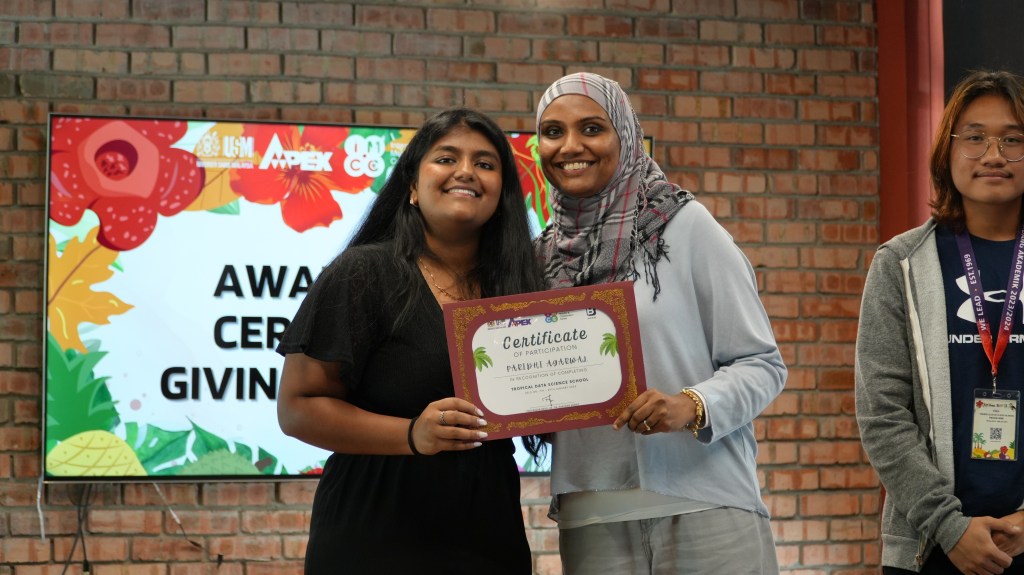
I had the amazing opportunity to participate in the Tropical Data Science School hosted by Universiti Sains Malaysia in Penang, Malaysia.
During the intensive two-week program, we had the privilege of participating in hands-on lectures delivered by industry specialists, covering a wide range of topics including statistics for data science, data visualization techniques, understanding consumer behaviour, and text analytics. The insights gained from these sessions were invaluable, providing us with practical experience and a deeper understanding of data science. We also got the opportunity to visit the Intel Corporation office in Penang and work on a group project utilizing tools such as Tableau and PowerBI. At the end of the program, we were able to present our project and make recommendations to relevant stakeholders based on our data visualisations and analysis. The academic experience of this program was truly enriching and significantly improved my understanding and interest in data science, while still being beginner friendly.
Penang provided the perfect backdrop for this short program, with its vibrant culture, breathtaking landscapes, and warm hospitality. I thoroughly enjoyed the cultural immersion activities such as Batik Chanting and Chinese Calligraphy as well as the day trip to Penang Hill, the guided tour of Georgetown and trying all the amazing food. Penang as a city is very easy to travel in and everyone is very friendly and ready to help. There are food options EVERYWHERE and everything is very cheap. As a group, we definitely took advantage of this and were able to try many different experiences, including food, activities and adventures!
One major highlight of the program was the buddies that volunteer from IMCC @ USM. They were genuinely the nicest and most welcoming people who had amazing organisation and coordination. They made our entire trip so smooth and fun, they are definitely one of the biggest reasons I would highly recommend this short program to everyone. Overall, the trip was very successful, and I am grateful for the unforgettable experiences, new friends, and dedicated mentors that made this journey truly exceptional.
Paridhi Agarwal Bachelor of Engineering (Honours) Diploma in Professional Engineering Practice Tropical Data Science School – Universiti Sains Malaysia Global Short Programs Travel Scholarship
My time at Sophia university has so far been the most valuable experience of my adult life. Firstly, it is an international university and is very English friendly. This may seem like a strange statement in a world where English is the de facto international language, however, I was not prepared for the lack English proficiency among the general Japanese populace. Largely I have seen this as a positive thing, it has forced me to go outside my comfort zone and attempt the little Japanese I have so far managed to learn. This does become quite tiring for someone who hasn’t come here to study the language, and so the ability to express any potentially major concerns or ask important questions (such as where to find an English speaking doctor) is a welcome convenience when the more mundane activities can at times be difficult to navigate.
Sophia is located in central Tokyo at Yotsuya station, only one stop away from Shinjuku. A major benefit of the location is that it is on the Chuo Line which runs from the very west of the prefecture all the way into the city centre. I live in Koganei, some half an hour away by train and between my station and Yotsuya there are countless suburbs with plenty of interesting and fun activities just a short walk from their respective stations. Living on this line is therefore extremely beneficial as the student Suica pass, which cost me around $400 for the entire stay, covers all trips going from Koganei to Yotsuya and vice versa. This means I can depart the train at any of the stations in between, or even visit these stations on weekends, all covered by the Suica card. While living in Japan has been far cheaper than Sydney, without the student Suica card, the train fares can become quite expensive if you are travelling two to five times per day, which is quite common.
My favourite place to visit after school is Kichijoji where they have an incredibly beautiful park and pond as well as many izakaya and yakatori as well as the Harmonica Yokocho famous for its standing bars. Here I often sit with a book and watch the ducks swim around as the sun sets on the water.
One of the courses I have been studying is a comprehensive introduction to Japanese religions and the park at Kichijoji has a gorgeous shrine dedicated to the incredibly important kami (Japanese deity) Amaterasu. Much of the course has been focused on religious practice of Shinto and so I have been able to observe the veneration and care of the shrine during my afternoon visits, a perfect way to see what I have studied be put into practice in the real world. Here is where I implore anyone reading to enrol in subjects specific to Japan. I study courses in Japanese history and religion and have found them to enrich my travelling experience. Not only have I learned about interesting historical and religious sites that would otherwise been unknown to me, but I have developed a far deeper understanding of their significance, making visits far more interesting than they otherwise would have been.
Adam Montefiore Bachelor of Arts in Communication (Journalism) Sophia University, Japan New Colombo Plan Mobility Grant
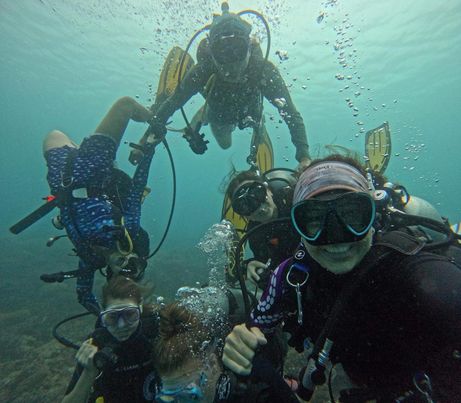
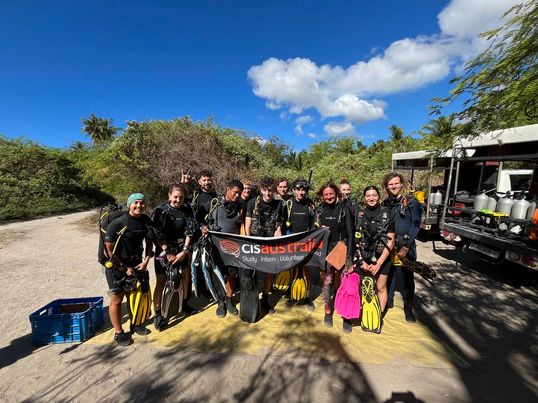
Diving on some of the most incredible reefs, twice a day, 6 times a week, for 4 of the most insane weeks of my life.
Our group of Australian uni students were indoctrinated into the life of a substrate surveyor and came to appreciate the complexity of coral and the interplay between reef structure, environmental conditions and the life that it sustains. Being able to identify corals, fish species and inverts plus understanding ecological processes within these ecosystems makes the world of diving even more rewarding. MCP takes a passive approach to conservation and works on surveying the health of the reefs. There was a big milestone recently as MCP now has enough data from previous years (8 to be exact!) that they can shift from comparing the data from Marine Protected Areas (MPAs) and non-MPAs to comparing MPA data across the years.
MCP is the brain child of two incredible people, Helle and Søren. I had the pleasure of listening to Helle tell the story of how MCP began. They’re the embodiment of good conservationists, employing transdisciplinary and co-design techniques from the get-go, most importantly a thorough understanding of all stakeholders at play. Locals, all levels of government, the tourism industry (especially diving), other environmental organisations, schools and of course themselves. Helle knew that she didn’t want to just be working FOR the community, but work ALONGSIDE them to achieve a healthy reef in order to benefit the locals and sustain their livelihoods. Throughout our time at MCP it was constantly reiterated to us that the Marine Protected Areas (MPA’s) are there to sustain the ability to fish and that local fishing is encouraged. They want a good rapport with the fisherman so that they feel comfortable asking for help when their nets are lost. MCP are more than happy to recover the lost nets as they can be expensive for the community to replace but additionally prevents them wreaking havoc on marine life. During our stay, Søren dove to 100m in an effort to recover a lost fishing net that was recently purchased with a grant the local community received. Unfortunately, it was unsuccessful, but if that doesn’t show a commitment to the community then I’m not quite sure what does. Sitting next to Helle I can really appreciate her poise and the calmness of her presence and I could understand exactly why the locals put their trust in her and Søren. Helle continued to explain that the best thing they’ve done in terms of education was to employ a local teacher. Often the alien presence of a foreigner in the classroom became the main attraction and although the children clearly enjoyed the workshops, the interaction dulled the focus on the environment.
One of THE most passionate and knowledgeable people on the MCP team is Caeser. A local who was originally a fisherman and a part of MCP’s maintenance team is now a Science Officer and Diving Instructor. Growing up on the reef his knowledge of the coral and mangrove ecosystems were unmatched and he was always down for a chat about any of these topics. He would also never fail to let you know how delicious something is to eat! Another amazing local staff member is Junior Science Officer and Instructor Bea! Just by her being around to chat to, I learnt so much, not only about fish and coral but Visayan culture and language and the infectious joyousness of Filipinos.
The most valuable knowledge I left with wasn’t learning the difference between an encrusting sponge or an encrusting ascidian but the realisation that MCP’s scientific and community success is rooted in the understanding that millions of people rely on functional ecological systems to be restored for their food and livelihood. I am so grateful to be able to contribute to this project and overwhelmingly fulfilled by the new relationships I’ve built. Thanks MCP <3.
Kiara Allison Bachelor of Science Bachelor of Creative Intelligence and Innovation Marine Conservation in the Philippines, CISAustralia Global Short Programs Travel Scholarship
The highlight of the experience, I would say, was the activity that I participated in for “Kindness Day”. I planted mangroves in Bangpakong Mangrove Forest, and I was also able to learn more about the site’s history. The lead conservationist explained how the mangrove forest we were on was planted over a decade ago by himself and his team, and we are now about to plant 800 seedlings, that we will be able to visit years later.
Playing a part in an activity that directly benefited the environment was a refresher from my studies. Those mangroves are planted to restore previously degraded mangrove areas, providing ecological benefits such as coastal protection, habitat for marine life, carbon sequestration and sediment control. The experience was filled with screams of delegates as they took a dip into the sticky mud, small crabs skittering every time we stuck seedlings into the ground, and peeks of mudskippers swimming around us.
Aurellia Widjaya Bachelor of Engineering (Civil and Environmental) BUILD – University Scholars Leadership Symposium (Thailand) BUILD Global Ambassador Grant recipient
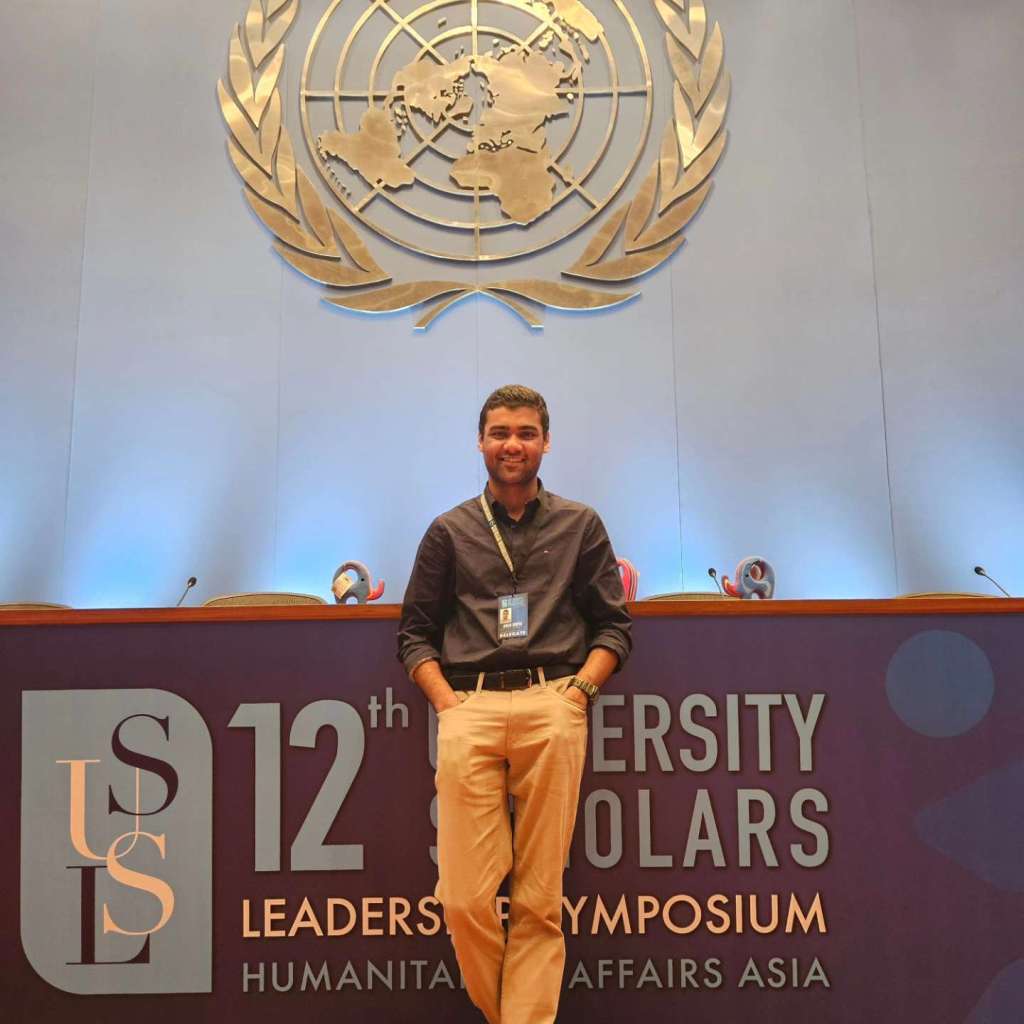
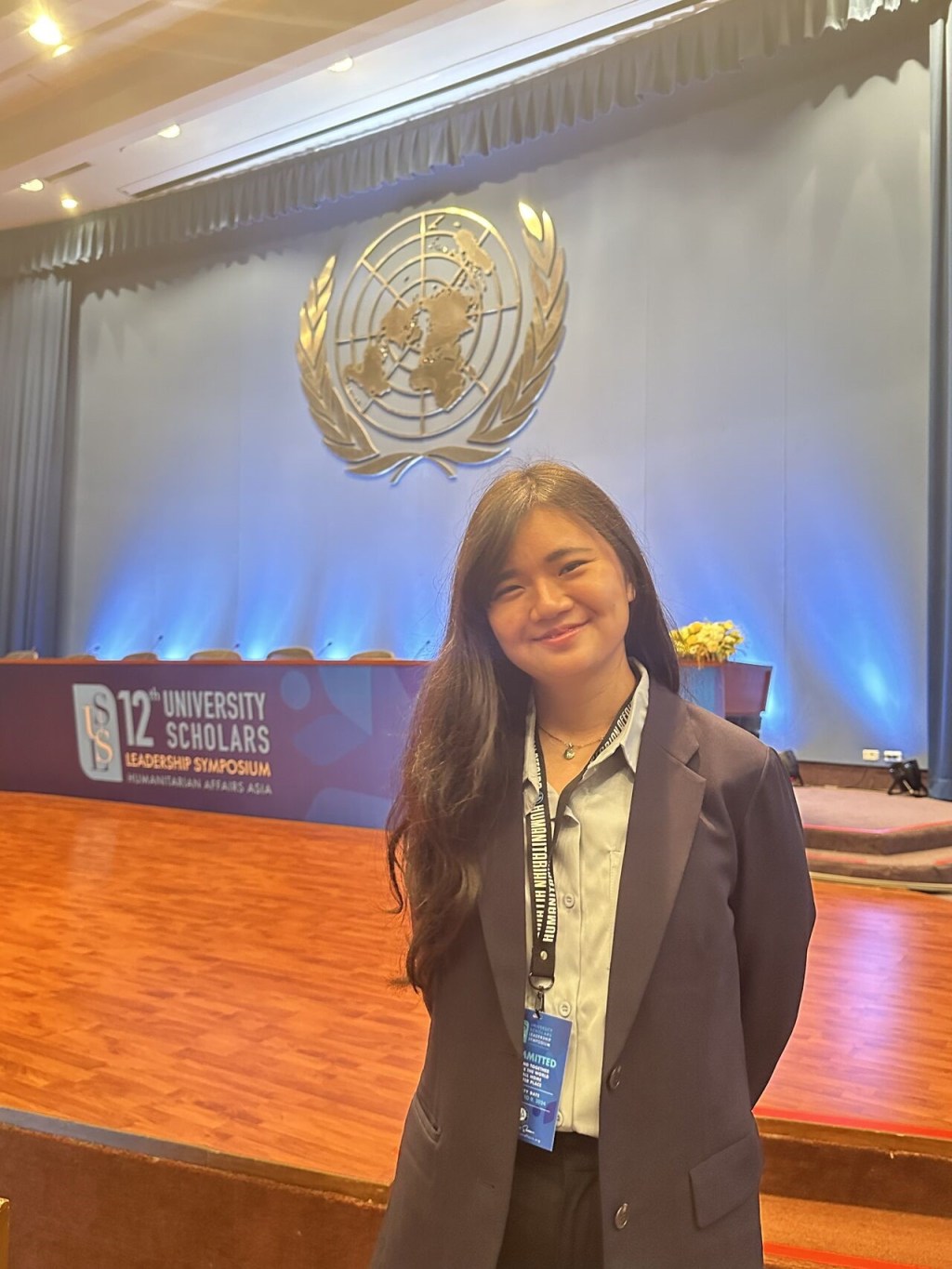
Reflecting on my Faculty-led Global Short Program at the 12th USLS in Bangkok, I enjoyed several unique experiences. I had the chance to represent my university at a prestigious event in the UN Conference Centre, which was both an honour and a learning opportunity. Meeting influential figures like Kim Solomon, Simerjeet Singh, and Janice provided me with insights and inspiration.
Participating in the kindness day event, where I helped paint a school, was a fulfilling experience that allowed me to contribute meaningfully to the community. And being featured on the big screen while asking questions to a speaker was a proud moment, showcasing my engagement and curiosity.
The program was an incredible blend of personal growth, meaningful connections, and hands-on experiences.
Arsh Gupta Bachelor of Computing Science (Honours) BUILD – University Scholars Leadership Symposium (Thailand) BUILD Global Ambassador Grant recipient
G’day! My name is Jacob and this January I left Sydney for Budapest to continue my studies in Architecture at BME, the technical university of Budapest. Eastern/Central Europe is often overlooked by Westerners but has so much to offer in terms of Architectural beauty, culture, art and history, and Budapest is no exception to this.
In my opinion this city is perfect for the student traveler experience. The subjects offered to exchange students are specifically tailored to be accommodating the exchange life style, with the subject workload being predominantly in class and practical which is great because you will definitely be travelling with class mates on the weekends to neighboring cities such as Prague, Vienna, Bratislava and more via cheap and convenient flixbuses and trains. Studying architecture here has been such a joy, the design studios really allow for freedom, and is greatly less stressful than what you will be used to in Sydney, the focus is really placed on your enjoyment and exploration of European design practices.
In terms of living in Budapest, the city offers great public transportation and walkability, as well as cheap food, drinks and a great nightlife culture. The Erasmus exchange organizations (ESN, ELB etc.) really go out of their way to organize lots of events, social gatherings and trips for incoming exchange students, you will make LOTS of friends within your first two weeks of the semester. The cost of living is exponentially cheaper than Sydney and you will be able to enjoy yourself fully in this city, as well as very cheap and affordable accommodation in the city (roughly 500-700 aud per month for a recently renovated flat in a nice area near the university). A week’s groceries rarely exceed $50 and there are plenty of restaurants where you can get a meal for less than $10.
The city can really be quite beautiful in the spring/summer, with plenty of parks to enjoy, including Margit island which sits in the middle of the Danube river, not to mention the Balaton Lake which is only a hours train ride from Budapest, which boasts a serene view, clear water and even thermal baths, perfect for weekend picnics and swimming.
With so many students from all over Europe looking to Budapest for their exchange, you’ll be guaranteed to meet so many people of different backgrounds and learn about their home countries and culture, who you will no doubt be looking to travel Europe with at semesters end.
If you are looking for a vibrant and alive city, with great night life culture, that’s cheap and close to other travel destinations I would strongly consider Budapest.
Cheers.
Jacob Chahoud Bachelor of Design in Architecture Budapesti Műszaki és Gazdaságtudományi Egyetem, Hungary Global Exchange Scholarship
I am so honored to be selected as one of UTS delegates to attend the 12th University Scholars Leadership Symposium at United Nations Conference in Bangkok, Thailand. I cannot express my feelings enough, how grateful I am I got this opportunity, how UTS BUILD supported me.
When I was 13 years old, I visited Japan International Cooperation Agency (JICA) as a school trip and it changed my life. I started to have a dream – I want to work as a teacher in developing countrired.
When I was 17 years old, I visited Cambodia for the first time as a volunteer. I taught Japanese sign language and song to Cambodian kids at school. I felt my dream came true, and it made me feel I want to do this kind of stuff more. Since then, I traveled to India, Sri Lanka, the Philippines and Indonesia to meet kids. Through these activities, I always felt I want to change the education system to give kids more opportunities, even if they are not from rich families. I am Deaf since I was born, I faced the discrimination issues, but if I have the ability to study, if I use English fluently, if I have the awesome skills like design (my major, yes actually I am not in education degree), people will admit me as a person, even as an awesome person. I have experience that through my life, SO I WANT KIDS TO FEEL THE SAME TOO. I don’t want kids to give up on their futures due to their current environment. My feelings for that is getting stronger every time I meet and teach kids.
Through this UN symposium, I got many hints to take action and make the positive changes from awesome guest speakers. I will start from building the trust between schools staff, teachers, and kids, and visit the school as much as possible. And I will BE THE CHANGE in the education of developing countries.
Thank you for much for giving me so much spirit and encouragement. I am thankful for the place I am here now. I will promise you now, I will change the world as a young global leader.
Yuka Maruyama Master of Interaction Design BUILD – University Scholars Leadership Symposium (Thailand) BUILD Global Ambassador Grant recipient