Through Immerqi and UTS BUILD I was given an opportunity to undertake an internship in Shanghai, I had family in Shanghai, so this trip would cover multiple bases.
My flight arrived in Shanghai early which was nice but when I came out of the airport it was sub 10 degrees which was quite a drastic change from the 30+ degrees weather I had experienced before I left Sydney.
The next day was orientation at Mandarin House, where I’d be taking Chinese classes twice a week for the next 6 weeks. Since I wasn’t staying at the university accommodation this would also be the first time meeting the Immerqi staff and the other UTS students who took this summer program. The orientation was a briefing of each company, the methods of transport to take, etiquette in China, protocol if anything went wrong and Chinese class timetable.
After the orientation we went to have lunch at the Shimao Festival City, a large shopping centre on the famous Nanjing Road. There was a 30-40-minute wait for the restaurant we went to, but it gave us an opportunity to explore the shopping centre. When out table was ready it was in a boat, it was a cool concept however it was a tight fit with 8 people. The food was good delicious and quite unique, hadn’t seen most of the dishes before.
Following lunch, we went for a walk down Nanjing Road exploring a bit and taking some photos, it had been raining so it was still a bit wet and the weather wasn’t too great. The end of Nanjing road was The Bund where Oriental Pearl Tower and Shanghai Tower resided, however due to fog the view was obstructed, the view of the bay was still quite nice, and the area was quite packed with tourists.
During the weekend I would just prepare for my first week of my internship, as I was unpacking I realised I had forgotten to pack my laptop charger, something that would be vital during my time in China. Luckily, I saw an Apple Store on Nanjing Road, so I headed there on the weekend.
The Immerqi program consisted of interning Monday-Friday from 9:30am to 6pm, and Chinese classes on Monday and Wednesday classes, with the weekends free. Waking up early and working 8 hours a day made me appreciative of the weekend. I was fortunate to have a friend from Australia who was in Shanghai when I was, he was able to show me around to new places, we had a fancy hotpot afterwards walking to West Nanjing Road where we went to the biggest Starbucks in Shanghai which was connected to a major shopping centre in the area.
I was there for Chinese New Year, which in China is a public holiday for the whole week. The briefing suggested that many people left the Shanghai to go overseas and it would be like a ghost town, I didn’t believe this until I saw it, a busy street crowded with cars and people was deserted during Chinese New Year. There was a lot of celebrations and promotions that week, it felt like an Eastern Christmas which lasted the whole week.
The internship was good experience and was able to learn a lot about the marketing industry and working in China, I was also able to improve my Mandarin through the Chinese classes. It was definitely a good way to spend the summer.
Since I
arrived at Louisiana State University, also known as LSU, in Baton Rouge,
Louisiana, I have been overwhelmed with how different the university experience
in the United States is compared to back home in Australia. I am lucky enough
to be staying in on-campus apartments which enabled me to have my own room
along with a shared bathroom and kitchen with my 3 other roommates, who are
luckily enough all local students, and this accommodation is completely
distinct to living at home back in Sydney.
I am
currently 1 month into my exchange in the United States and have been lucky
enough to travel to New Orleans, Atlanta and Washington DC before I commenced
at LSU. In the United States, every state and city is completely unique and all
3 of these cities gave me a great insight into the local history and culture.
Specifically, New Orleans has been my favourite city so far because of its
blend of American, French, Portuguese, Spanish and Afro-Caribbean culture and
rich history that sets it far apart from the rest of the United States.
The
Southern Hospitality in Louisiana is shown by everyone as the locals go out of
their way to help anyone and this ranges from driving people around campus to
giving out free food and drinks at a tailgate on gameday. The sense of pride in
LSU is shown by almost everyone, whether it be students or even locals, wearing
an item of clothing with the LSU logo on it. Also, the idea of Greek life at
LSU with fraternities and sororities is something that we don’t have back home
and they host multiple events throughout the year, including tailgates,
parties, formals and networking events.
The
facilities at LSU are truly world class and they have everything on campus that
a typical college student could ever need. This ranges from the unbelievable
UREC Complex which spans nearly 25,000 square metres, with an indoor running
track, rock climbing walls as well as a lazy river shaped in the university’s
initials. Additionally, the UREC Field Complex has 4 softball fields, 8
multi-purpose sports fields, a soccer stadium, a baseball stadium and the
100,000 seater football stadium, known as Tiger Stadium. The college football
team, the LSU Tigers, is the pride and joy of Louisiana and have started the
season undefeated, which defied all pre-season expectations. Amazingly, the
mascot for the football team is a Bengal Tiger, named Mike the Tiger, who lives
in a zoo right next to Tiger Stadium. Additionally, the atmosphere at my 1st
LSU Football game was nothing like I have ever experienced before with the LSU
band playing the college songs and fireworks being shot out of the stadium.
I was lucky
enough to have saved up 4 electives in my degree to use for my exchange in the
United States and I decided to use these to take up US History and American
Politics subjects to learn more about America. This is very different to
studying Accounting and Economics back in Sydney and allows to gain a unique
perspective on the local history and culture as well as maintain my passion for
history and politics from high school.
Matthew D’Cruz Bachelor of Accounting Louisiana State University United States ISEP Program
Recently I travelled to Thailand to complete UNBOUND’s design for social change program. This was only made possible with the help and support of the University of Technology, Sydney’s BUILD department and program.
The BUILD Abroad experience was the best way to finish off my university degree. The UNBOUND design for social change trip grave me the chance to explore the culture of another country while being taught the human centred design process. The facilitators did an excellent job of ensuring the right balance of experiencing local culture, then applying that learning to develop more sophisticated and holistic solutions.
While on the trip as students we were given the chance to engage in a wide variety of cultural traditions. While experiencing local life our facilitators ensured that we understood how we could empathise a design solution to fulfil all of our stakeholders needs. As an experience this meant thinking differently about the challenge and moving away from the classroom into a less developed environment.
Interacting with the local people was a new experience as we were not able to speak a common language. This meant being patient and focusing on specifics to ensure our ideas and their suggestions were not being lost in translation.
The conclusion of the trip was focused on pitching our developed solutions to the UNESCO in Bangkok. This was a great way to formalise our design concepts ensuring we would still receive the high level feedback needed to understand the impact of our ideas.
As a student this was the first time I have had class located in a rural town within Thailand. This meant that I was not sure what would be involved or if it would be the right way to go about continuing my engineering learning. The risk that it wouldn’t be for me stemmed from the fear of putting myself into an unknown position with unknown people. I could not be happier with the results. I feel that I have gained lifelong friends and taken away one of the best learning experiences I could have hoped for.
My attitude towards the people who took care of us in the homestay has grown positively and I cannot wait to return one day to see them again. As an engineer I believe the project experience has made me a more empathetic and patient thinker when developing future solutions. As a student being thrown into an unknown group of people I believe I have become a more sincere all rounded friend.
Again I am extremely thankful for the opportunity and will highly recommend anyone who can to utilise the opportunity to take the chance to go on the same trip.
The trip: Day 3
Day 3 introduced a different side of Bangkok. The group was up bright and early, ready to experience the Klong Toei community, generally accepted as the slums of the city.
The group was welcomed by a passionate group that was eager to bring forward change in the community. Following a presentation about Thailand’s startling wealth and social disparities, a guided tour was given on the different areas of Klong Toei. Here the group saw first hand some of the issues faced by the community.
After a local style lunch, the group tried its hand in some decorative flower designs. It quickly become apparent that our very own Derek may have missed his calling after he presented a beautiful flower design.
The second half of the day involved the initial stages of the action projects. Teams were formed and community issues chosen. It was now time for some team building activities. Team’s split up and analysed possible group dynamics. Looking at group strengths and weaknesses in hope of avoiding any future issues. It was then time to prepare for the initial contact with the community in day 4. Team’s analysed possible stakeholders and how they may be affected. Teams then drafted questions that may aid in defining the problem for teams action project.
Finally, after a tasty food court feast, the group boarded its first overnight train, next stop Pha Pang.
Day 4
Today was our first day in the village of Pho Pang, a small community with a rich and lively culture. As tired as we were from a bumpy sleep the previous night, the atmosphere and activities during the day were filled with so much energy and vibrancy that we were left too awestruck to recognise our fatigue.
We were first taken to the community centre, where we will stay for our fourth night in Pho Pang and they gave us a briefing of the community and their many values. After which, we left our belongings in our respective houses (being split into male and female accommodation) and we were taken to the first of two Buddhist temples and taught how to make flower cones. Once completed, we offered the flowers to our own zodiac signs, which were all cemented in great white structures outside the temple. Mel and Kaia directed several workshop activities through which we were able to develop ideas for our projects, before we were taken to the next Buddhist temple where the community prepared for a funeral held in the not-so-distant future.
We assisted the members to make roofing out of bamboo and banana leaves. This activity proved an optimal chance to ask about our projects and interview the members about the community’s needs. We spent close to half an hour talking and reflecting on the interviews, before we walked back to our accommodation. On the way, we met a sweet little primary school student who was very happy to get a photo with us all.
Dinner and a movie was shared, along with laughs and some heads already nodding off to sleep.
Day 5
We were lucky enough to start our day with breakfast prepared by our host families, which was the perfect meal that helped us power through our early morning brainstorming. Next up, we travelled to the Pha Pang school where, with the help of the students, everyone enjoyed learning a traditional Northern Thailand dance and song.
Following a delicious pad Thai lunch, one group visited the community’s kinder while the other went to the healthcare centre to gather vital information for their action projects. A short time later we found ourselves at a bamboo plantation where we got to see bamboo charcoal being turned into energy.
One of our last activities was following along with a health and fitness class run regularly at a temple. The upbeat songs and steps were enough to get everyone’s heart beats racing. Finally, the day ended with yet another delicious dinner followed by some fun group trivia.
Day 6 – Organic Farming and Rural Life in Thailand.
Today we headed to an organic farm. Here we met the owners and the local family who live a sufficient life. An important concept in Thailand that refers to how the farming Thai people choose to live self-sufficiently using their land equally to grow rice, fruit and cultivate cows, pigs, chickens and fish.
After learning about how the rural Thai farmers support themselves into a healthy life style we began to work on our prototypes.
We ended the day by experiencing a local dinner and learning about the full moon kratong festival.
Day 7
It was the group’s last time waking up in the homestay tonight. For our first activity, we painted bamboo cups with images and inspirations we found from the community, such as the flora and fauna and the activities we have partaken in so far. We talked and laughed with the elders, telling them what we have enjoyed about Pha Pang and how grateful we are for their hospitality. The elders then blessed us with good luck and each elder tied a white strand of wool around our wrists, so that the luckiest of our group eventually ended up with ten woollen bracelets.
We then bid farewell to our homestays and our hosts, who have made our time in Pha Pang homely and relaxing, and then moved our belongings to the community lodge. From here, we split into two groups, one of which stayed at the community lodge and worked on their project pitch for tomorrow and the other travelled back to the farm to complete the prototypes.
For dinner, we sat around small tables in the Community Centre and listened to some of the elderly members play Pha Pang’s traditional music. We then watched a dance performed by local primary school students and all danced and sang together as a united community.
Day 8
In the morning, we presented the prototypes of our designs to the community. It seems like they liked our solutions. Then we visited the bamboo innovation centre to see the various uses of bamboo.
In the afternoon, we said goodbye to the Pha Pang community.
We spent the afternoon working on our projects and prototypes. After arriving in Chiang Mai we experienced the night market sensation which stretched for kilometres over the old city.
Day 9
Today our group was lucky enough to experience a different side of Chang Mai. The group was up bright and early, ready to experience the different temples surrounding the inner city.
The group was welcomed by passionate community leaders that were eager to bring forward change.
Part of the temple adventure included a traditional silver temple. Unfortunately men could only enter the temple, a continuation of ancient ritual, and the women could watch on a virtual screen outside. This temple was unlike any other we have seen to date. It’s artwork was extremely modern and included depictions of aliens and even electric guitars. These unusual artworks contained hidden gems that could only be acknowledged through careful examination.
Just before enjoying a local style lunch, the group tried its hand at making some traditional style artwork from tin to represent the silver used within the traditional temples.
The second half of the day began with a visit to a successful social enterprise Aka Ama Coffee. During this visit we were lucky enough to hear a story of a local community creating its own free trade coffee brand to create more wealth for its struggling people.
Returning back to the hotel we separated back into action teams to continue working on our human centred design projects.
Finally, our group was treated to a romantic dinner at the flower gardens on the edge of Chang Mai. Dinner was amazing and the photos were beautiful.
Day 10 – Final day in Chiang Mai
After a pitch lesson from Kaia, Jeremy kick-started the day with an improvisation game.
The social enterprise visit in the morning started with a quick zero waste shop where people stocked up on products of their choosing. Lisa Byrd, the owner of Free Bird Cafe and Thai Freedom Cafe, told us about her experiences and work with Burmese refugees, which was surprising and impressive.
We listened to the most impressive and in-depth story of how she began to understand the atrocities of human trafficking and how she designed a social enterprise to help and support and educate those who have no power. The success of the idea began by giving those who don’t have a choice the ability to learn the local language so that they may understand there situation. And then give them the opportunity to find real jobs which would give the ability to move out of the human trafficking construction camps.
This was followed by pitch work at the museum cafe, and Thai massages all round. After a small rush to the station, we were pleasantly surprised by a much nicer sleeper train and dinner.
Day 11
We woke up on the night train headed back into Bangkok. Bused to a kayaking social enterprise where we learned about rubbish being dumped into the rivers of Thailand. Enjoyed a kayaking experience where on our return journey we tried to collect as much rubbish as possible. The collected HDPE (high density polyethylene) found would be used to create more kayaks in the future.
The group then headed back to the original hotel to continue to work on our projects and prepare to present to UNSECO.
Day 12 – Bangkok Design Week
Creative ways to influence Bangkok and Thailand’s design future. This featured a plastic exhibition that highlights the use and disregard of the waste of products. It also showed and highlighted how if used properly and recycled how the resource could be used for positive impact.
Wild aid social enterprise. Conservation to tackle illegal wildlife trade. Action projects designed to use the influence of celebrities to stall the demand of wildlife projects. Their motto being when the buying stops, the killing can too.
Day 13 – Final day
Today we took a journey to the Thailand branch of UNESCO. Here we first heard the story and work that is being done to help educate and define the most critical issues facing the education amongst people around the world.
We were then given the opportunity to pitch our projects and ideas to the people of UNESCO formalising our entire project path. The educational study tour has been and amazing experience and I would recommend it to anyone who has an available elective.
Hello! Here I am, back in Sydney after a month-long whirlwind of a trip to the other side of the world. Travelling to the United States, I was one of 28 people who undertook a subject which saw us visit architecture by the likes of Mies Van Der Rohe, Frank Lloyd Wright, Frank Gehry and Zaha Hadid.
Starting off our journey in New York City, we were given the opportunity to roam free in the Big City. Loosely planning our days based on a list of buildings given to us in the subject outline, I think it is safe to say that NYC provided us with days jam packed full of fun, adventure and exploration. Getting around on the Subway made us immediately feel like New-Yorkers and let us get from A to B with ease. Not only is the subway cheap, it is also full of surprises – including some of the best buskers I have ever heard. While in New York we visited Central Park, the Met, MoMa, the Guggenheim, SANAA’s New Museum, The Statue of Liberty (via the Staten Island Ferry), the Oculus by Calatrava, the 9/11 Memorial Pools and Museum, One World Trade Centre, Time’s Square… the list goes on. I think its safe to say that there is always something to do in NYC.
The Guggenheim – New York City
A couple of other highlights included going to an NBA game at the Barclays Centre in Brooklyn. A NY derby saw the New York Knicks play against the Brooklyn Nets, and boy did they put on a show! When in New York be sure to get to a basketball or ice hockey game… the hype is something not to be missed. Another highlight was dollar pizza… I mean who doesn’t love pizza, especially when it costs only one dollar?!! We went to 2 Bros pizza on 8th Ave. It was fresh, hot and deliciously cheesy… and crazy cheap of course! My final favourite NYC moment was visiting the High Line. If you love architecture, cute dogs or just seeing cool stuff you must take a walk along the High Line. Designed by Diller Scofidio + Renfro, the High Line is an elevated walkway that has repurposed a derelict metro line into a corridor of green space. Approximately 3 miles long, the High Line is surrounded by projects from the likes of Zaha Hadid, Frank Gehry and Jeanne Gang. Walking along, I couldn’t help but take way too many photographs. It is pretty much architectural heaven.
The Oculus – World Trade Center, New York City
Moving on to Chicago, we touched down on the tarmac hours before the Polar Vortex hit. With temperatures dropping to -35 degrees, -45 degrees with wind chill, I had never been so cold in my entire life. It was reported as the coldest day in Chicago since 1985 and hit temperatures below the North Pole AND Antarctica. All this crazy weather meant that our first day in Chicago was cancelled, but there was nothing stopping us from visiting the Farnsworth House the following morning.
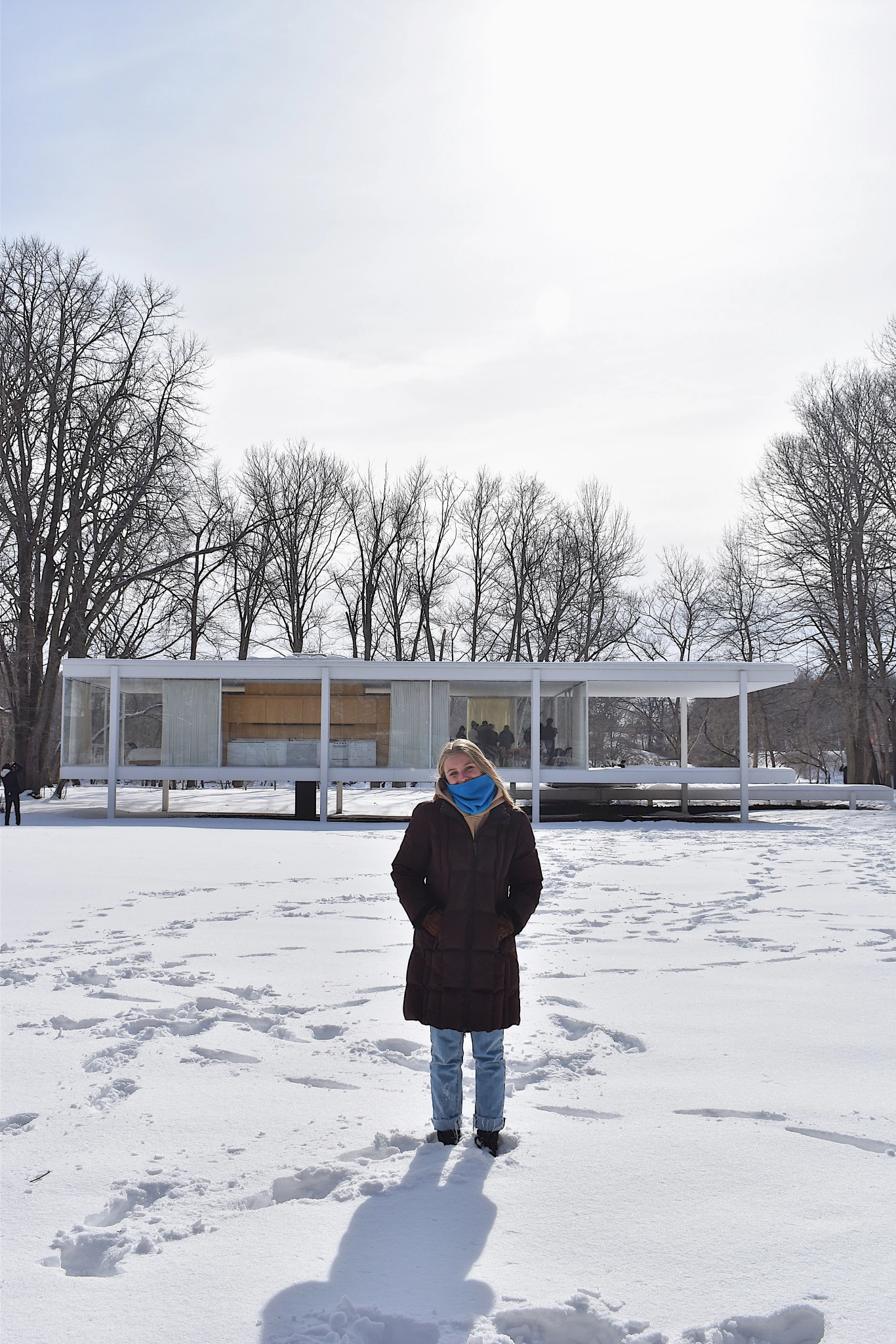
Despite the crippling cold, the Farnsworth House was utterly incredible. Surrounded by almost 4 feet of snow, Mies’ glass masterpiece was an incredible sight. Despite the subzero conditions outside, inside the Farnsworth House was warm and cozy. This was quite shocking given that the house is made entirely from single-pane glass and structural steel.
Farnsworth House – Chicago
Other highlights from Chicago included Frank Lloyd Wright’s Unity Temple in Oak Park, Frank Gehry’s Pritzker Pavilion, The Bean (CloudArch), The Sullivan Centre, The Monadnock Building (featuring the first Chicago Bay Window), and Jeanne Gang’s Aqua Tower. Overall, I totally loved Chicago and would love to go back when the weather is warmer!
The Bean (CloudArch) – Chicago
We then made our way to Los Angeles for the final leg of the trip. It was a welcome relief to strip some of our winter layers and enjoy warmer temperatures. Checking in at a beachy Santa Monica hotel, we started off our LA leg with a free weekend. Exploring Third Street Promenade, it was nice have a day to do a bit of relaxed shopping and looking around.
Some highlights included a trip to San Diego where we visited the Neurosciences Institute and Louis Kahn’s Salk Institute. A trip to downtown LA included a visit to Gehry’s Disney Concert Hall, the Broad and the Bradbury Building. We were also given the incredible opportunity to spend a day at Frank Gehry’s architecture firm which left everyone mind-blown. The Sheats-Goldstein residence was another stand out project we visited. With a multi-million dollar view of LA and a private nightclub for Mr Goldstein’s events and parties, this house had everyone in awe. With crazy architectural complexity and attention to detail this house was almost too much to take in!
The Broad – Downtown LA
Disney Concert Hall – Downtown LA
Sheats-Goldstein Residence – Hollywood Hills, LA
Stahl House – Hollywood Hills, LA
All in all, our trip to the US was packed full of experiences that I will never forget. It was a great way to meet new people, learn about both myself and my profession, and see things that I will never see again. A trip of a lifetime.
Before this UTS Global Exchange, I have travelled round Sweden multiple times between November – February during the winter season where the weather is freezing cold and snow covers the ground beneath your feet. I’d never experienced a Swedish summer before and felt as though now was a great time to experience this and study in a country renowned for its incredible education system. So, it is safe to say landing in 33-degree heat in the middle of July, in a country I thought I knew inside out was a total shock to the system! That’s right believe it or not a Swedish summer can hit temperatures as drastic as 30+ degrees. Although the heat was quite unbearable, it was the beautiful Swedish nature with its crystal-clear lakes and bright green trees which turned things around for me. It was like I was seeing this country for the first time with fresh eyes!
Seeing as I had a few weeks break before my exchange was to
start at Stockholm University, I made the most of my time exploring the city
centre, testing my fear of heights at Stockholm’s famous summer theme park
Gröna Lund, taking multiple FIKA (Swedish expression for coffee & cake)
breaks and visiting some of the many swimming spots scattered round the various
archipelagos of Stockholm. I also was lucky enough to have one of closest
friends from Sydney come visit me in August, and together we spent some time in
Sweden as well as sailing along the coastline of Croatia.
It is now September which means summer has officially come
to an end and the Autumn weather has most certainly kicked in. Already the
leaves on all the trees are turning orange, and you can see everyone is preparing
for the freezing temperatures to come. However, September also means the start
of my global exchange! Last week was our University’s orientation week which
consisted of various activities coordinated by the Student Union (SU) which is
a student-run organisation in charge of various Uni related events, dinners,
parties and activities. SU are also dedicated to helping all incoming
International students assimilate as quickly as possible and make various new
friends from all around the globe. You can buy a SU membership for the semester
which gives you a range of privileges and discounts around campus, so I’d
highly recommend joining if you’re considering Stockholm University. Seeing as
I wanted to meet as many people as I could I made sure to attend every activity
such as the IKEA visit, guided bus tour of Stockholm city, speed-friending
event, pub crawls and welcome parties. Already I’ve met some amazing people and
have been even lucky enough to make some Swedish friends (which they do say is
quite impossible!). The thing with Swedes is they’re very reserved people at
first which is hard for Australians to understand, but once you get to know
them they’re so kind and welcoming.
This week my classes are now in full swing and seeing as I
used my free electives to go on exchange, I am studying three subjects called
‘Sweden – Society & Everyday Life’, ‘Education in a Multicultural Society’
and ‘Swedish Language for Beginners’. I’m excited to learn more about this
country and its culture, and I look forward to the coming weeks. The beauty of
Swedish Universities is the semester is divided into two periods, so I’m
technically only studying one subject per period with the Swedish language
course on the side. This leaves you with loads of time to travel, party and
socialise with your new friends. Oh… and to ‘study’ as well!
Thank you UTS for this incredible opportunity to study abroad, and I can’t wait for the next 6 months of my exchange.
Chloe Howard Bachelor of (Business) Management Stockholm University Sweden
As a multicultural nation, Singapore faces the difficult challenge of bringing together communities of different ethnicities, beliefs, cultures and languages. As the focal point of the subject, it was fascinating to see how this reflected in every aspect of Singaporean culture: from packaging and signage, to community spaces and entire suburbs. I would not have known the extent of this had I not visited the country for Interdisciplinary Lab B (Global)
As one of the 19 students who visited Singapore for the two-week program, Interdisciplinary Lab B was an enriching and rewarding experience. For the first week we had the opportunity to visit three distinct areas of Singapore: Kampong Glam, Chinatown and Little India. Kampong Glam, the Malay sector, was picturesque with beautiful mosques (Sultan Mosque) and boutique lanes (Haji Lane, Arab St). In Chinatown, the new year was rapidly approaching so we were treated to celebrations and markets revolving around the Year of the Pig. The intense scents of herbs and spices were vividly present in Little India, as they too set up for their own Harvest Festival. As the focal point of the second assessment, each came with their own heritage design challenges, including loss of culture in some cases. Visiting the Heritage Centre in each district, I developed an understanding and appreciation for their unique cultures and histories.
Malay Heritage Centre
Historically, Singapore has been recognised as an international trading port, connecting countries together. More recently however, Singapore has experienced a transformative socio-cultural shift from international trading port to thriving business hub. It was incredible to observe this in the Singaporean urban landscape, with its multistorey, modern skyscrapers juxtaposed with the old heritage buildings like Hawker Centres (Lau Pa Sat) and Temples, like the Sultan Mosque. These contrasting architectural designs, so different to Australia, really cemented the fact I was truly overseas. That, and the humidity which I never got used to!
Singapore’s true multiculturalism is something we can all learn from in Australia. I would 100% recommend Interdisciplinary Lab B (Singapore) as a subject to undertake due to it being such a wonderful, enriching study experience. I feel that it has added to my studies as a visual communication student in a unique way by broadening my horizons. As my first time overseas by myself, there were many challenges I had to overcome and I feel that by dealing with these, I have become more resilient, adaptable and independent.
The idea of doing a semester abroad had always interested me but was something that seemed a little bit unrealistic. So when the opportunity to do a short-term international trip with UTS BUILD came up I jumped at the opportunity – especially when I found out that the International Management Field Study was in Vietnam, as it was somewhere that I had never been.
I have been to a couple of Southeast Asian countries before, so I thought that I knew what to expect when we were finally in country. However, I was pleasantly surprised by how progressive Ho Chi Minh City and Hanoi actually were. Obviously, it’s still a developing nation, but many of the urbanised areas mirrored elements of Sydney, and you could tell the extent of the development as old and new buildings juxtaposed each other.
We conducted numerous business visits while in Vietnam, encompassing a range of different industries such as education and tech, expanding across NGO’s and multi-national corporations. These visits added a lot of value to my degree because they contextualised so much of what I am learning in a business degree on a global scale. I have lived abroad before but wasn’t sure if that is something that I wanted to do again once I had finished my study. But being exposed to multi-national businesses and hearing the experiences (both good and challenging) for expats actually made me excited at the prospect of living overseas again.
The culture in Vietnam was really unique and easy to become immersed in, I loved the sense of community that was felt as you saw people in the streets with friends or working. I had some basic knowledge of Vietnam’s history before going but being faced with the reality of things like the Vietnam War and the impact that it still has on people today was shocking – this was really highlighted when visiting the War Remnants Museum in HCMC.
Despite this, and the reality of the tragedy that can be quite overwhelming, what really stood out to me was the resilience of the Vietnamese people, especially the women, which was highlighted to me in our visits! They’ve have worked so hard to be where they are today and are continuing to overcome monumental challenges, yet still manage to have such a positive perspective. I think this is something that I will always carry with me as it has shifted my perspective.
I was nervous going into the trip as I didn’t know anyone, this really pushed me out of my comfort zone! I was so glad that I did this though because I was lucky to be in a group of students who were all happy to talk to everyone and were really inclusive. The cultural experience aside, it’s amazing what you learn about 30 other people, and yourself, while travelling.
Overall it was a great two weeks, between the travel, business visits, cultural sites, exploring and dinner I don’t know how we managed to do so much! I loved that we moved from HCMC, to the Mekong Delta and then up to Hanoi. It gave me such a dynamic overview of an incredible country. It is really hard to pick a highlight from my time in Vietnam, so I think I will have to go back and do it again!
I would gladly define “above and beyond” as an exposition of expectation and experience.My 4 Weeks in the Unites States of America was a fast paced, vortex of an Adventure. 70+ Houses, Sites, Landmarks, Buildings and Landscapes visited and a whole archive of drawings, memories, photographs and life changing events created. New York, Chicago & Los Angeles as well as cities like New Jersey, New Canaan, Pasadena and La Jolla. It was a parallel experience to that of Australia. Diving from 45 Degrees Celsius in Sydney to – 50 Degrees Celsius during the Polar Vortex in Chicago. An absolute seesawing atmosphere which conflicted with the viewing of each Site we visited. From bitter cold winds of New York to the snow consumed city of Chicago and to Sunny Los Angeles. The Modern American Architecture kicked off first towards the end of our New York part of the journey.
[Interior] Farnsworth House, Chicago
Architecture in our course is seen as a multitude of areas, covering elements of art, graphic design, philosophy, history and all of the above. There is no defiant singular nature in Architecture,however it can be seen through the lens of the different styles and timelines of architecture linked to the urbanity and cityscapes of the different parts of the world. Hence seeing three major cities within the Unites States allowed a flexible view on the sites we visited and explored how they could be deciphered and connected. Something which deeply sparked the elation of undertaking a global studio was to see the transition from understanding a site from a textbook or as reference point to its physical magnitude and presence. To be able to understand Architecture in its intended experience is a vital milestone in my university education and career as a Future Architect.
[Exterior] The Oculus, New YorkFisheye Lens [Interior] The Oculus, New York
NEW YORK – THE CITY THAT NEVER SLEEPS
Whilst in New York for 11 Days, It was previously made clear that it would be a self guided tour of the city. I made an itinerary with some of my fellow first year students and we set out onto our daily adventures to different destinations and sites. Some of these included the Rockefeller Building, Central Park, Empire State Building, one World Trade Centre, The Met, MOMA, SANA, The Guggenheim Museum, The Whitney Museum, 9/11 Memorial, The Oculus, One World Trade Centre and several other destinations. Most days consisted of an 8am Wake up time, and a continued touring day till 4pm in which the sun would set. I would strongly recommend this amount of time for Students to successfully see almost everything within NYC. From my observation it was highly accessible, where Uber, Taxis and Subway transit systems are sewed into the very fabric of the city. The enriched metropolitan American culture thrives off the urbanity, and it truly never sleeps! On the day before the departure to Chicago, Our Global Studio met for the first time in Grand Central Station. It was a great experience in which we travelled to New Canaan to Visit the Glass House, A mile stone in American Architecture as it integrated both external nature and internalised landscape into the house. It was definitely a testament to the ideology of reverse ageing. Above and Beyond what it was for its time.
Unhistoric Townhouse – System Architects, TribecaDumbo, Brooklyn – New YorkThe Met, New York
CHICAGO – THE SUBZERO CITY
29th January 2018, Bye bye New York! Hello Frosty Chicago. Well where do I begin? Chicago was the original city of the modern skyscraper. At -50 Degrees celsius, there was a state wide warning for the dangerous temperatures outside. Two days of the trip to Chicago were cancelled due to the Polar Vortex which swept the city. Some of the highlights though include the visit to the famous Farnsworth house and the numerous sightings of the Frank Lloyd Wright collection such as Unity Temple. Consistently gazing at the Chicago Skyline, I deeply admired the communication between monumental, Historical and Modern architecture in which they simultaneously occupied the cityscape harmoniously, an unspoken dialogue.
Cloud Gate, Millennium Park – Chicago
LOS ANGELES – THE CITY OF ANGELS
At last, Sun. Welcome to tropical Los Angeles. Although very different to Chicago, the weather in Los Angeles felt eerily familiar to that of Sydney. Santa Monica was an absolute retreat from the cold and was a paradise of shopping, beaches and sun soaked boulevards. Taking a step back, the Architecture in Los Angeles dramatically shifted to the California Bungalow and expensive Hollywood houses. The excessiveness of these houses empower and go beyond the aim and standards of architecture in which are practiced today. This included the Sheats-Goldstein Residence, The Stahl House, Gamble House and the Gehry Residences. Speaking of Gehry (The creator of the UTS Paper bag building AKA Building 8), We took an exclusive tour of the Gehry Partners Studio where we were immersed into the several past, present and future projects. I uncovered the layers and depth of the design process which is involved in these projects, and the introduction of new materials, testing and approached to representation, relatively important to how I may pursue my work in my second year in Architecture School. After Taking a trip down to La Jolla, We visited the Sulk Institute. Architecture at its finest in a sense of perspectival consideration and deep ties with the natural and progressive thresholds of the site. On a different note, I was able to begin networking with the Alumni of UTS in the Penthouse of the Shangri-La with my fellow colleagues. There were so many interesting people that night. The conversation kept flowing and it was remarkable how much people can have in common when they share the same interests, values and origin point. Exciting yet daunting, it was overall a marvellous experience.
Salk Institute, La Jolla – San DiegoSheats-Goldstein House, Hollywood
Ultimately, My time in America has been a once in a life time experience that will forever leave an influence on my work on a dramatic scale. To be enlightened and engaged in Architecture on a physical and tangible realm has been a rewarding sentiment for me. I would definitely recommend this to any student who wishes to pursue a deeper focus in Architecture, Art or History as it will play a huge role in how you see and interpret your own understanding of your own profession. To be able to take in what you have experienced in your life and then to be able to produce something out of it is truly remarkable.
Helo o Brifysgol Caerdydd! After spending the summer travelling Europe, I have arrived at Cardiff University. Cardiff is the capital of Wales and is a city that is full of history, culture and has a vibrant young student population. The university is very conveniently located in the city centre, right near shops, pubs, clubs, the castle and various sports stadiums.
With 30,000 students and the vast majority of students living in university residencies there is always something to do. I am staying at a university apartment block called Gordon Hall, there are around 50 students living here, I have my own bedroom with an ensuite and there are always people around to talk to.
Cardiff is also a great location for cheap flights to various European destinations on weekends and is another reason I chose to study here. Orientation week or ‘freshers’ week as it is known here is amazing, there are so many different activities for everyone, whether it be sports fairs, pub crawls, clubbing, city tours or day trips around Wales. It is a great way to meet people. Cardiff is also a great city for sports fans, with Cardiff City FC playing in the English Premier League the city transforms every time there is a home game, the atmosphere is intense. Rugby is absolutely massive in Wales and the Principality stadium, which holds 75,000 people, is also located in the city centre. Australia play Wales here next month and it will be huge!
Being an exchange student and studying free electives means that I can pick subjects from a range of different academic schools. This gives me an option to study subjects that I would not have tried back home such as history, computer and earth sciences. The university also has a large amount of sports clubs from trampolining and airsoft to rugby and football, whilst over here I’m playing both football and American football. The university facilities are brilliant, there are 18 different libraries, 2 sports centres, cafes in almost all buildings and the students union which is the spot on campus where everyone hangs out; it has bars, TVs, restaurants and supermarkets.
Cardiff has so far been a great place to study and I can’t
wait to see what the rest of the year brings. I highly recommend it.
Brian Carr Bachelor of Business Cardiff University Wales, United Kingdom
I participated in the January 2019 UTS intensive language course at Beijing Institute of technology. Having just finished Chinese 4, I wanted to go on an intensive language course that enabled me to put into practice what I’ve learnt from my Mandarin classes and gain new cross-cultural skills.
Intensive language classes took place every day for 1.5 hours in the morning. Our teacher was excellent and despite the challenges of all the UTS students having different language levels (from absolute beginner to Chinese 4) I felt that my speaking abilities improved. The language courses covered critical vocabulary and skills for our time in Beijing. I have learnt some of these grammar points and words already during my Mandarin classes at UTS, but the themes included ordering food, seeking help, sightseeing, directions and describing our trip. The cohort also took part in culture classes every afternoon. During these, we learnt about traditional Chinese culture practices such as the tea ceremony, calligraphy paintings and, thanks to our visit occurring just a few weeks before Lunar New Year, we were also taught about the cultural significance and practices of the Spring Festival.
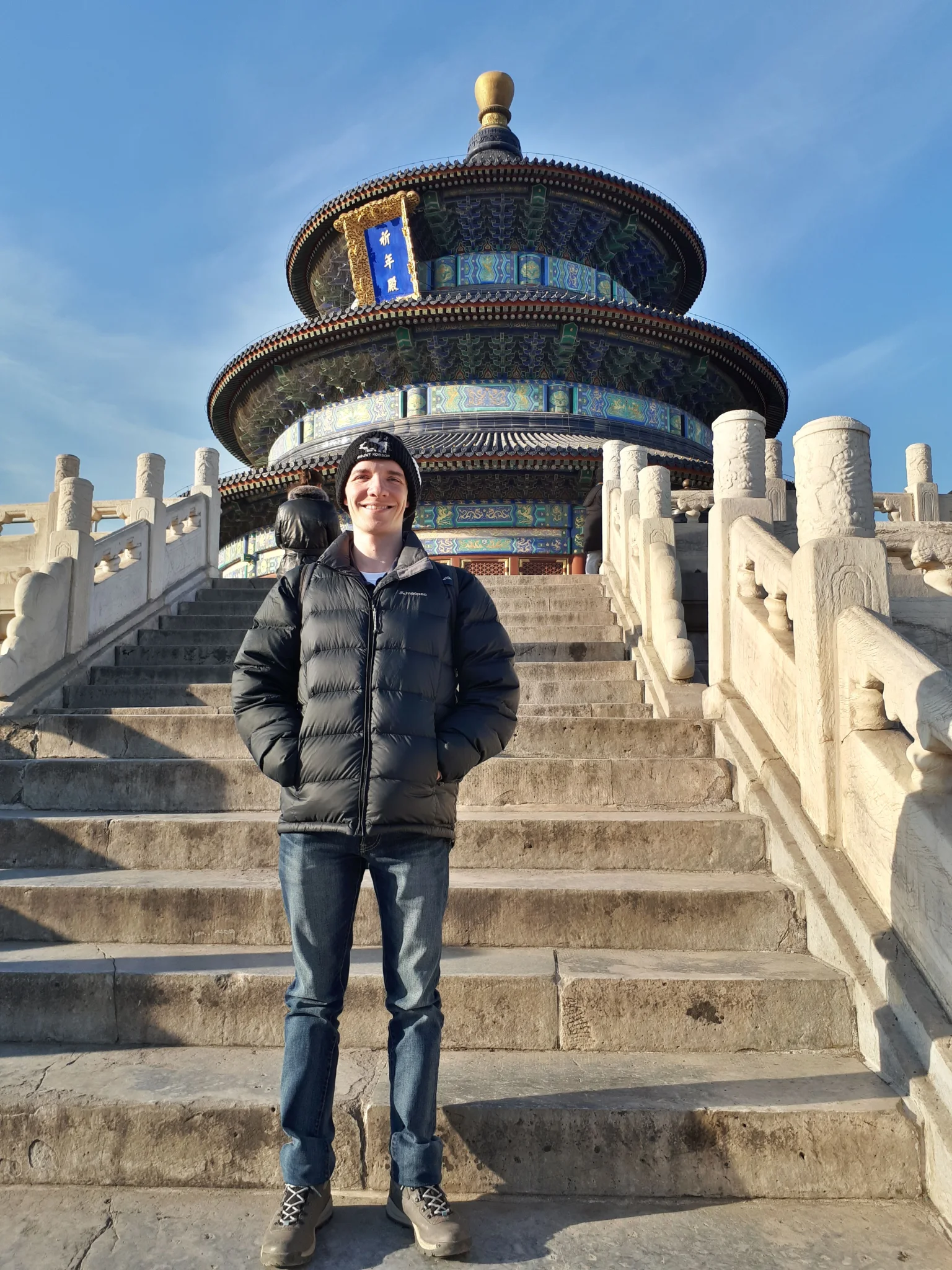
We also went on several excursions, to places such as the Temple of Heaven, Summer Palace, Great Wall of China, Tiananmen Square and the Forbidden City. During these excursions we were given free rein and just told to be at a specific meeting point at a certain time in order to be transported back to BIT. All these sights were remarkable in terms of their construction as well as their rich history, the immense detail and ornamentation were extraordinary and truly breathtaking.
There was also a lot of free time afforded to us due to the lack of classes which allowed for independent sightseeing. Initially the cooler weather was a fun change from the Australian summer heat, I found it impressive just how good the heating was in Beijing but also very odd at how hot it was inside buildings. I often found myself rugged up to combat the cold weather only to be sweltering once entering a building and having to strip off some of my many layers. With this free time, I was able to explore the more metropolitan aspects of Beijing as well as venture to places such as Longqing Gorge to attend the Ice lantern festival.
It was fascinating to see China’s rise and rapid development in person, and Beijing is the perfect metaphor for modern China – a contrast of the new world and the old. A highly developed and sophisticated subway system roars beneath old vans selling street food and the occasional scooter van. Soaring glass skyscrapers of unprecedented design and engineering feats tower over the hutongs – Old Beijing’s cramped alleyways, traditional houses and cultural centres.
Nowhere is this contrast perhaps more astounding than Tiananmen Square. The square, being the 4th largest in the world, is an ominous icon that celebrates the power and rise of the Chinese Communist Party. It is surrounded by imposing buildings of socialist realist architecture that symbolise the epicentre of communist China – the National Museum, the Great Hall of the People and the Mausoleum of Mao Zedong. Many hundreds of people gather for a photo in beneath the Monument to the People – taking pride of place in the very centre of the square. Every sunrise and sunset, hundreds line up to see the impressive flag raising and lowering ceremonies. It is distinctly different civic experience to ours in Australia and it was good to learn about this different culture in person.
I’m grateful to have had the opportunity to visit Beijing, study the language and learn more about the culture. In these times of rising international tensions, it is vital that people-to-people links are strengthened through educational and cultural opportunities, for we can all learn from others.