This intercultural experience as part of the criminology intensives internship program provided me with an understanding of Australian relations with the Indo-Pacific. The internship provided us with the capacity to conduct an academic research project that explored whether vulnerable groups could access justice in different capital crimes that challenge the central operations of Indonesia’s Criminal Justice System.
Visit to a contemporary art museum
Through this process, we were able to produce a group research paper that displayed our newly gained knowledge of how Indonesia’s societal structure contributes to the crime and criminality of the space. This trip made me realise that culture shock can be experienced both interpersonally and professionally. Whilst I understood how a nation’s socio-cultural and political sphere can impact its very core operations, hearing about some extreme cases through our interview was a whole different kind of culture shock to us. I recall visiting the local legal aid agency and Amnesty International Indonesia, and being rendered speechless when we were told that these agencies can be even at risk of being bombed for speaking up against structurally embedded issues that are persisted by governmental corruption. In understanding this aspect, we were able to approach the other local criminology agencies with a newfound sense of empathy and open-mindedness to the sensitive topics of discussion.
We all came into the program with almost no language capacity, but I was able to pick up small phrases throughout the trip and the local students and staff appreciated us for even our smallest bit of effort. Combining these connections with our existing skill sets from our degree, I was able to gain a high level of empathy in an intercultural setting whilst also learning about the criminology agencies in the local area.
Photos with the staff from Amnesty International Indonesia
Additionally, being able to try new food and make friends with people from different cultures was enriching to both my personal and professional life. While I was placed in a space where I had to learn to be open-minded, I also gained expertise in cultural humility, which forced me to reflect on my position as a global citizen. Overall, I would love to return to different parts of Indonesia and learn more about the culture and language, after noting that different parts of Indonesia have their own customs and traditions.
Ashly Liu Bachelor of Criminology, Bachelor of International Studies International Internships, Universitas Indonesia New Colombo Plan Mobility Grant recipeint
Last year whilst I was deep into the UTS spring semester I received an email in my inbox: “Explore Data Science In Paradise”. Usually, I would ignore such a bold claim, but eager to procrastinate my work, I read the email and was amazed by the opportunity it provided.
Fast forward a couple months later, and I found myself in the stunning Penang with 22 other UTS students and my amazing buddies at Universiti Sains Malaysia (USM). Through the Tropical Data Science Summer School at USM, I was able to expand my knowledge of a key emerging area in my field while also exploring a UNESCO World Heritage-listed city. This was an experience of a lifetime and I would highly recommend students to take up the opportunity next year.
We were greeted at the airport by our buddies holding up signs with our names on them and I immediately felt so welcomed and excited for our experience in Penang. On our first day, we were given a tour of USM and their grounds could not be more different to UTS. The grounds are huge and lush, with greenery everywhere, and even a Mosque.
I was immediately impressed by the sheer qualifications of all our lecturers. Every lecturer had multiple degrees and a PhD, and I could feel their passion in the way they led their classes. Throughout the two weeks, we covered topics from data visualisation to neural network modelling. We even got to visit Intel Penang and learn about how they are harnessing data science and AI. We ended with a presentation showing visualisations on a provided set of data which we had to analyse ourselves using software such as Tableau and Power BI. It was a great introduction to the world of data science.
Throughout our stay, our lectures were mixed with cultural experiences. We were able to do artwork in Batik style, Henna, Holli, and Chinese Calligraphy and learn lots of Malaysian slang such as adding “Lah” to the end of sentences. We could never go a day without using “Jom lah!” (let’s go).
Of course we were able to explore Georgetown and Penang Island after class and on the weekends. My favourite excursion was definitely bike riding through the scenic countryside or riding the world record-holding longest waterslide at the Escape theme park. I tried countless different kinds of Malaysian cuisine, the highlights being learning to eat with our hands with banana leaf rice, roti pisang, and our local Nasi Kandar.
Overall, I came into this trip with no expectations and ended up making many new friends, experiencing a culturally diverse country, and learning about data science! The main thing that made this trip stand out was the incredible buddies from Universiti Sains Malaysia. Our buddies planned all of our excursions and cultural activities and ended up becoming amazing new friends from across the world. We were able to learn about Malaysia from the locals and have authentic experiences. If you ever get the opportunity to participate in the Tropical Data Science School, do it!!!
Caitlin Murphy Bachelor of Engineering Tropical Data Science School – Universiti Sains Malaysia New Colombo Plan Mobility Grant
Bonjour from Paris! Recently, I had the incredible opportunity to embark on a two-week short exchange program at the Paris School of Business, a journey that delved deep into the realms of Fintech and Business AI. This program wasn’t just an academic endeavor; it was a cultural and professional immersion, blending learning with real-world exposure in one of the world’s most dynamic cities.
What truly set this program apart was how perfectly it combined study and exploration. Paris, with its iconic landmarks and vibrant culture, became an extended classroom. We had plenty of time to balance academics with the adventure of discovering a new city. This blend of study and sightseeing was truly inspiring.
During the program from the first day, we were tasked with creating a business element involving an AI concept, and mine centred around customer personalisation in e-commerce. For my project, I envisioned a system that could analyse a customer’s past purchase history, browsing behaviour, and preferences to predict and recommend products they’d be genuinely interested in. The aim was to enhance the online shopping experience by personalising their shopping experience. We’re talking about a smart interface that could tailor the website in real-time, creating personalised product sets, and even recommending entire outfits complete with sizes based on past purchases. This was built on the foundational AI concepts we had learned in class. We discussed sentiment analysis, machine learning phases, and the importance of balancing bias and variance in model training.
Another highlight was visiting Station F, France’s largest start-up hub. What made it a spectacular experience for me was witnessing the vibrant ecosystem where a thousand start-ups thrive under one roof. What really stood out to me was the sense of community and diversity. The entrepreneurs I met came from all walks of life, each with unique stories of perseverance and innovation. It was here that I saw the future of business and technology being shaped, and it has left me with a newfound excitement for what my own future may hold in this rapidly evolving field.
Reflecting on my time in Paris, it wasn’t just about learning new concepts in Fintech and Business AI. It was about seeing how these technologies are transforming our world. This experience broadened my horizons, connected me with global peers, and provided a platform for cultural and professional exchange. As a young student, this journey was more than just an educational trip; it was a step into a world where technology meets culture, innovation, and real-world application. Paris, you’ve been an absolute dream! 🌟🇫🇷
Alina Stojcevski Bachelor of Business Paris School of Business, France Global Short Programs Travel Scholarship recipient
I have to admit that in the beginning, I wasn’t that excited about going to Nottingham. I had initially applied to a different Global Short Program program which was cancelled, and the Photography and Heritage subject at Nottingham Trent was the next best thing. But after two weeks capturing iconic British landscapes through my camera and indulging in pub feeds, England might have captured my heart after all.
Instead of the uni accomodation, I chose to sub-let a room in a local student share house. So when I arrived on a rainy Saturday evening, my new housemate picked me up from the bus station. This accomodation choice allowed me to be able to immerse myself in the student life that Nottingham is famous for, enjoy walks through the beautiful Nottingham General Cemetery to class every day, and learn all the tips and tricks on cheap UK living (like the Tesco meal deals – a small meal, snack and drink for only £3!). It was quite exciting to live in a share house with Nottingham Trent students, and I had so much fun getting to share all the funny similarities and differences between Australia and England.
The two week photography course kicked off with a walk through Nottingham City, familiarising ourselves with the streets and learning all about the historical quirks. The week that ensued was jam-packed with excursions, lots of walking (I hit my step count goal every day!), and countless photos taken. We visited Newstead Abbey, Matlock Bath, and Sherwood Forest; immersed at every location in the mystical ambiance of the British countryside.
Whilst photographing at each location, we would hear the voice of our tutor telling us to capture ‘within’ life instead of ‘of’ life. He wanted us to seek strange, unique perspectives; to look deeper than surface level instead of capturing the literal. In those two weeks I felt my love for photography re-flourish, and my eyes instinctively wandering for little moments of magic to capture.
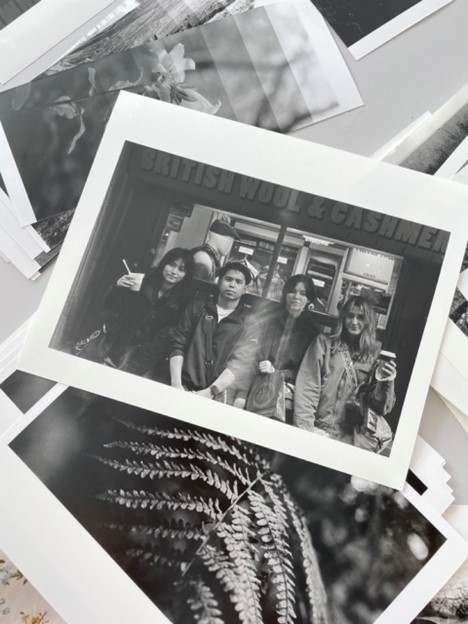
After a week of outdoor classrooms with cameras in our hands, it was now time to edit, develop, and curate. Whilst I had thrived being snap-happy on our excursions, my favourite part of the program was the three days straight spent in the dark room. Our tutor’s passion for film photography and the developing process was palpable in the way he explained and supported us through this new medium.
I really enjoyed the intentionality and slowness of the developing process, editing images not with Photoshop – but with light and our hands. This time in the film lab was the perfect time to experiment and make the most of resources that I normally wouldn’t have access to.
With all of our film images developed, and our digital pictures edited, it was time to curate them into a photography book. We ideated a concept, selected our images, hand-cut each page, and hand-bound the book. We all finished our pieces on the last day of class at Nottingham Trent, and spent time flicking through the whirlwind of memories we had captured in the past two weeks. This book now sits on my shelf at home, a special souvenir from my photographic journey in the UK.
Victoria Fernandez Jones Bachelor of Design in Visual Communication and Bachelor of Creative Intelligence and Innovation Nottingham Trent University Summer School Global Short Programs Travel Scholarship recipient
Hi everyone! My name is Rebecca and I’m currently studying a combined Bachelor of Science in Information Technology and Bachelor of International Studies! Here’s a quick 3 month check in of how my life in Japan is going.
Picture 1
What am I studying?
For my ICS (in-country study) component, I’ve had the honour of studying at Ochanomizu Women’s University in Tokyo as part of the first cohort for the EDI (Equity, Diversity and Inclusion) program. This program is in collaboration with Ochanomizu’s counterpart universities in the United Kingdom, Canada, Australia and from next year USA. This program is approximately 7 months, starting from July up until the end of January, and my schedule looked a bit like;
Starting the online component of Ochanomizu’s Summer Program (2 weeks)
Participating in-person during the Summer Program (2 weeks)
Break (1 week)
Internship (2 weeks)
Summer Holiday (3 weeks)
Autumn Semester (October to January)
My Autumn study plan currently consists of 8 subjects/16 credit points – which is what I was informed to be the legal requirement in maintaining your student visa status – with 3 completely in Japanese and 5 other subjects ranging from topics such as language and globalization, gender and social sciences, and Japanese society related subjects. Since these are part of the program, there is a requirement to study subjects related to career design, gender, and globalisation. All these subjects are technically not direct equivalents because my UTS study plan only has Exchange Elective 5, 6 & 7!
How’s my host university?
My host university has quite a small campus with buildings and classrooms that remind me of my primary school and high school. Despite this, it’s really homey and has great areas to lounge around. The best parts include our campus animals (we’ve got 3 campus cats, a bunch of turtles and koi fish – all of which live right outside our library!), as well as the school cafeteria! The cafeteria has such an amazing variety of Japanese food, all for such a low cost (you can definitely get full off of ~6 AUD). There’s also this tree in the middle of the main building courtyard, that blooms cherry blossoms during Spring (around mid-late March!).
Although Japan is perceived as a technologically advanced society – just like how its acknowledgedfor still using fax machines and manual labour in business operations – Japanese universities still thrive on paper handouts and online portals/systems that look like UTS Blackboard (for those who remember what that looked like…)
The teaching style for my classes mainly consists of lectures, with some student collaboration here and there, not so much tutorials or workshops like what I’m used to in Australia. Most classrooms are set up like a typical high school classroom, with tables and chairs arranged in pairs or rows and a blackboard up the front, or a projector with white pull-down panels.
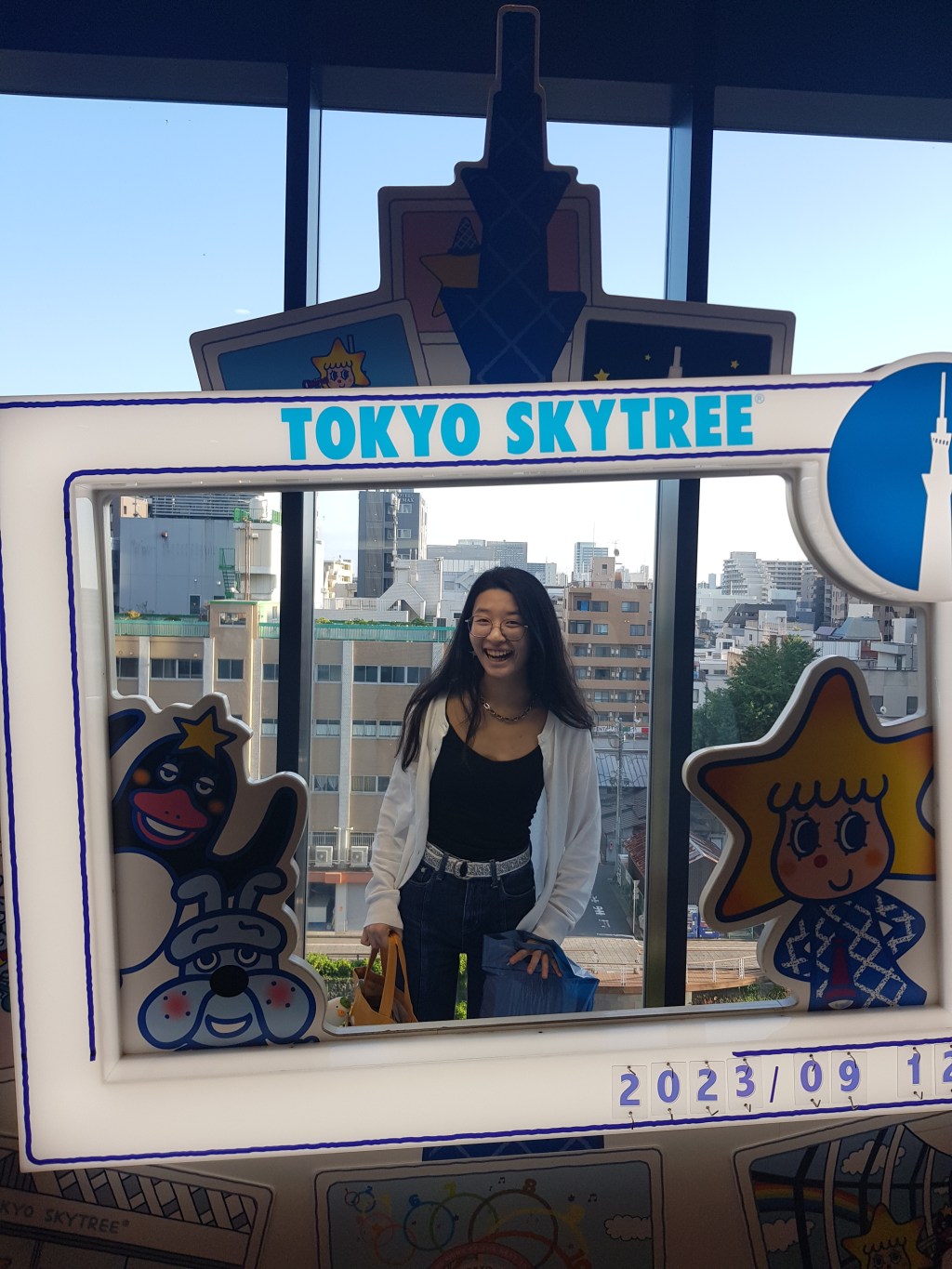
Picture 2: A Day Out
How is my life outside of university?
I’ve got a bit more of a genuine local experience, being that I live in the suburbs as opposed to on campus accommodation. It’s still an international student dorm, but I’m commuting around 40 minutes a day to and from university, which in itself was challenging but it’s grown on me.
One thing about Japan is that you’re going to be walking a LOT. I’m averaging around 10,000 steps a day, and the first few months was incredibly challenging. The stations are huge, the shopping districts are equally huge, and many station exits don’t have elevators or escalators so if you’ve got weak knees like me… best of luck.
In all seriousness it does grow on you, and it feels (not necessarily factual…) like I’ve been a more fit since arriving in Japan than in Australia. My friend who arrived back from exchange said that ‘walking becomes a happy lifestyle’, but I’m still waiting for the happiness that comes from walking so much. Maybe it’ll dawn on me when I arrive back in Australia.
What do I do in my spare time?
I’m the type of person that is terrible at planning overseas trips and can’t really get around to all the ‘touristy’ or ‘Instagrammable’ locations. I’m also terrible at booking in advance as well as waiting in line. So, what can I really do in my spare time?
My answer is: a lot. The best thing that I’ve done in my 3 months here so far is exploring the small cosy suburbs and streets in my area and around Tokyo, as well as really fleshing out my hobbies, discovering what I can do with those hobbies, as well as pick up some new ones along the way.
I love coffee, street dance, art, photography, fashion and exploring. A lot of my time is really dedicated to scoping out great cafes, thrifting clothes, art gallery hopping, or appreciating the local scenery and foods. I also love taking a train to a really far destination and taking pictures – sometimes it’s planned, sometimes it’s spontaneous and often it’s a mixture of spontaneity and planning. I’ve met some lovely locals and internationals along the way, and always make sure to ask for recommendations on what my next adventure should be. I’ve also attended some street dance battles to see what the Tokyo scene looks like in comparison to Sydney. I’ve also planned on trying out some new hobbies. I’ve been meaning to get into physical activities such as bouldering, badminton, and taking more street dance classes. One new hobby – and skill – that I’ve been able to hone is making my own drip coffees! I really recommend you try out something you’ve been meaning to start, or think of new things to explore, because the best time is when you’re away in a different country for a short period of time with the luxury of not having to work.
Picture 3: A Coffee x Vintage market pop-up that I was invited to by my baristas from a cafe I frequent
Closing thoughts
People often say that exchange is a ‘life changing’ and ‘identity defining’ experience. I would agree to that to an extent, but in my experience it’s not as glamourous or romantic as it might sound like on paper. I’ve had my hardships and struggles with loneliness, feeling like I’m wasting my time and not being productive, or even just feeling like why am I even in this country? It’s very human to feel like this, because being in a new country where no one knows you (and a country as respectful and reserved as Japan) is terrifying and incredibly lonely. But in this short time away from home I have been able to find out what I like, what I don’t, what I can do if I put my mind to it, and who I can meet if make the step to get out of my house and step out of my comfort zone. I’m incredibly fortunate for my experiences and opportunities thus far and wouldn’t change any of it at all.
Tips for those looking to study in Tokyo/Japan
Don’t stress too much about not getting a spot on your campus dormitory – if you have a backup in the suburbs of Tokyo or larger cities in Japan, this is an equally rewarding experience, and you tend to find even cuter and niche areas of your local area/city!
Don’t ever compare your own exchange experience to others in the light of ‘I should’ve done that”, or “I should travel around more”. Do what you enjoy, and don’t think like you’ve missed out on making the most of your exchange experience because you didn’t get that one Instagram picture or visit that incredibly famous location/restaurant that you had to wait in line for 2 hours for. I felt like this a bit as I flicked through my friends’ social medias, but in the end I was happy with where I was in my stage of life, and my experiences along the way.
If you can speak Japanese (or not!) make sure you ask your baristas, bartenders or owners or places you frequent about their recommendations for other cafés, restaurants, or locations! You can often make a friend along the way, as well as experience a whole different side of Tokyo every time.
If you struggle with loneliness or you’re an extrovert like myself, the best way to meet people is just put yourself out there. Go out to somewhere by yourself or with a dorm buddy. Talk to the person next to you in the bar. Join a local event or meetup. Don’t let rejection or failed attempts to talk to people get to your head. Japanese people are typically quite reserved and don’t tend to make the first move to talk to you, so if you don’t put yourself out there then it’ll be a tiny bit harder getting to know people here. Also please do so respectfully – treat others how you’d like to be treated!
Rebecca Lu Bachelor of Science in Information Technology and Bachelor of International Studies Ochanomizu Women’s University Japan
It has been just over 3 months since I departed into San Diego for exchange. College life here is absolutely amazing, with SDSU being the best choice I could have ever made.
Regarding academic life, it is very different with more frequent assessments scattered around the semester with low weightings. This avoids the whole final exam having so much pressure, which I absolutely love. I am studying primarily entrepreneurship-based subjects which I have enjoyed. Many professors have their own approach and doing multiple subjects like this has led me to develop a diverse perspective on being an entrepreneur. The facilities are nice at SDSU, old architecture with a modern interior twist. Classrooms are exactly like the movies, especially with the chairs connected to the desk.
Amazing sports facilities especially with nearly 6 turf fields, a football stadium and basketball stadium. Teaching varies between subjects but recurring themes I picked up on that are different from UTS is that it is very much discussion-based classes. The whole class consists of discussions with the professor for most of the time. Professors want you to talk and discuss with them rather than spoon feeding you content. I am so glad that my classes do not have the lecture and tutorial format, instead one class that combines both.
Life in San Diego is amazing. I live just 10 minutes away from campus, a shuttle bus away, so it is still convenient. My routine is very different from Australia as living with other college students leads you to go out and explore whenever you have free time. The arrival program at SDSU was done very well with a big seminar teaching us everything and a bowling session to meet other exchange students. This was a great opportunity, where I met a lot of my friends.
The most surprising thing I found was that San Diego was not as warm as I thought it would be, but that could be because I came in during one of the coldest periods they have ever experienced. Also, I found it very interesting how much pride Americans take in their identity. Everywhere you go people have hoodies of their university, favourite sports team, club team and much more. They love having a sense of identity and they are very proud of it. What I enjoy the most is spending weekends either partying or traveling America.
Tips for future students would include:
Pack very light, buy more apparel over here like SDSU merch or just clothing as it is cheaper.
Avoid skipping classes, as once you start it become a habit.
Still maintain some routine in your life. For example maybe on a Sunday do a general house clean up and sort out your week.
Nikhil Gokul Bachelor of Business San Diego State University United States of America
I was unsure what to expect when I attended my first BUILD event, the Introduction to Leadership Workshop. I expected it to be a boring conference in which we sat and did icebreakers for the entire time before hearing the speaker lecture. I was mistaken and was pleasantly surprised by the outcome! This event focused on the ins and outs of becoming a leader. The room was filled with like-minded BUILD members eager to expand their knowledge and grow as a leader. This workshop has taught me a few tips and tricks for becoming a successful and confident leader.
I’ve always been told that a firm handshake is important in life, but we learned in this workshop that there’s a lot more to standing out in a room. It could be the way you present yourself, how you stand, how far away you are from the other person, or the type of questions you ask during the conversation. There was no time for timidity in the workshop; we were there to learn, so the best way to do so was to become uncomfortable and participate. We looked at all of the important stages of a conversation. Communication is one of the most important aspects of the workplace. With good communication, much can be accomplished, and there are no unclear spaces or other issues that arise as a result of poor communication. Then we discussed public speaking and how to engage an audience. Public speaking requires practice and is not easy, but learning some tips at this event boosted my confidence. We then finished by defining the type of leader you are. This may sound general, and why should it matter what type of leader you are, but at the end of the day, learning which leadership qualities you possess and identifying the qualities in people with whom you work best can result in a strong and productive team. To be successful, one must embrace differences. If everyone was built the same way, the world would be a boring place with few accomplishments because everyone had the same ideas. Embracing differences can help you build stronger relationships, create a more enjoyable workplace, and make everyone happy.
All of the key takeaways from this experience will be useful in the workplace, and I plan to apply the skills as soon as possible. I realized how much room there is for growth and that I will never stop learning. At this event, I was also able to connect with people from very different workplaces and life experiences. It was great to meet people from all over with the same goal in mind: growth. We were encouraged to share linked in information with the people we met, which could be a useful tool in the future, because who knows where the world will take us! I will remember that piece of advice and apply it more! I am grateful for this workshop and will definitely attend future events hosted by BUILD, because learning never ends!
Elle Nicholson Exchange Undergraduate Student from theUSA
One of my interests when I first came to this country as an exchange student from the United States was learning about the indigenous people. I never learned anything about Australian history in school back home, let alone the history of the aboriginal people. Since I’m not very interested in history or museums, I was excited to have the opportunity to participate in the coal loader adventure because I knew it would fulfill all of my curiosity.
This was a unique experience that started with a presentation on the history of the Aboriginal people, which made me realize how little is known about them and how Australia would not be the same without them. Sadly, a large portion of their history has been lost, neglected, or simply disappeared, leaving few artifacts for people to remember. It is upsetting to see the struggles they endured and continue to endure. I found the Aboriginal people to have a strong sense of identity, pride, and self-worth admirable. After that, we went on to the coal loader for a tour and brush walk, where we saw some interesting tunnels and rock formations that we had discussed earlier in the presentation. Finding out about how they used the surrounding earth to survive and heal, as well as how much fresh food they consumed when they first arrived, piqued my curiosity. It was fascinating to observe their diet because I study nutritional sciences at my home university. It is devastating to see that after their land was taken, they never again ate the same. I am appreciative that I have discovered this history, and I have gained a great deal of knowledge that will benefit me both now in Australia and in the future. It has made me more aware of the difficulties individuals deal with on a daily basis.
I had the opportunity to interact with other BUILD members during the field trip. Each of these members has a unique background and set of perspectives. I am always learning as an exchange student. The build community is made up of incredibly welcoming and inclusive people. In addition to learning, I share my life experiences to everyone I come into contact with. Since the United States and Australia seem to be very similar, when I first came here, I assumed that all I would be doing was learning about other people. However, I quickly started sharing the knowledge and insights that people are interested in learning about me.
I am now aware of the wider world around me. Thanks to this field trip, my questions have been answered, but I’m eager to learn more. Not only should I study more about the Aboriginal people, but also about the history of everyone I have met. I’ll put the knowledge I acquired from this field trip to use by imparting it to others and using I am now more interculturally competent as a result of this experience. I have a greater awareness of the new culture I’ve entered. As a member of the BUILD community, I am pleased to find that it is powerful and supportive in transforming ideas for change into reality.
Elle Nicholson Exchange Undergraduate Student from theUSA
I am currently studying electives in Chinese Languages as part of my exchange program at Tongji University. My electives include Listening, Speaking, Reading and Writing which are all taught by different teachers. Tongji University has many different campuses and my campus is located at the Siping (四平路) Campus. Siping Campus has amazing facilities such as sports centres, gyms, libraries, convenience stores and food courts. Their food courts have a range of different cuisines which are all delicious and extremely cheap.
The teaching style in Tongji is quite different from UTS as we follow textbooks rather than course outlines, we also have early classes (8am-11:35am Monday-Friday), which makes me feel like I’m back in high school. As I am in a Non-degree program, there isn’t something called lectures and tutorials, it’s more just like lessons which I guess is very similar to tutorials at UTS. All the teachers in the International School are very helpful and outgoing.
Orientation was quite hectic as I wasn’t given much information on when and where I had to register. I also arrived in China during the Chinese New Year holiday period, so everyone was on break. However, the teachers at the International School office were really helpful and assisted me in completing the registration process.
The first few days in Shanghai honestly weren’t the best as I did not have a phone number and debit card which meant that I could barely do anything. However, life became amazing after I got everything done especially after my Alipay 支付宝 and WeChat Pay 微信支付 started working. I am currently living outside campus alone rather than in student accommodation at TongJi as they didn’t have any left.
Accommodation is much cheaper than in Sydney, however it is still quite expensive in China. There are a lot of limitations for International students living in China in terms of accommodation as not a lot of apartments or places accept International students. Only government-accredited apartments or housing places can accept International students making it hard to look for housing.
TIPS for students who are going on Exchange to China
First thing you must do before you even go on exchange is to make sure whether you are living on campus or outside. If you are living outside you should get into contact with agents to ask about accommodation availabilities and arrive 3-4 days before school start so you have time to check out the accommodation. If you are living on campus double check with your coordinator whether you can reserve because most universities don’t do reservations.
Once you land in China, remember the first thing you should do is to get a phone number. You can go to 中国电信 ( or any other telecom company) with your passport and tell them that you want to get a phone number. This process takes around 30 minutes.
After you get your phone number, you can then get your debit card done. Some banks in China cannot open bank accounts for foreigners, I went to 中国工商银行 to open my account. You should bring your passport and acceptance letter in order to open a bank account.
You must have a debit card and phone number to register things such as Alipay and also signing accommodation contracts.
Lauren Chen Bachelor of Communication (Media Arts and Production) and Bachelor of International Studies Tongji University China
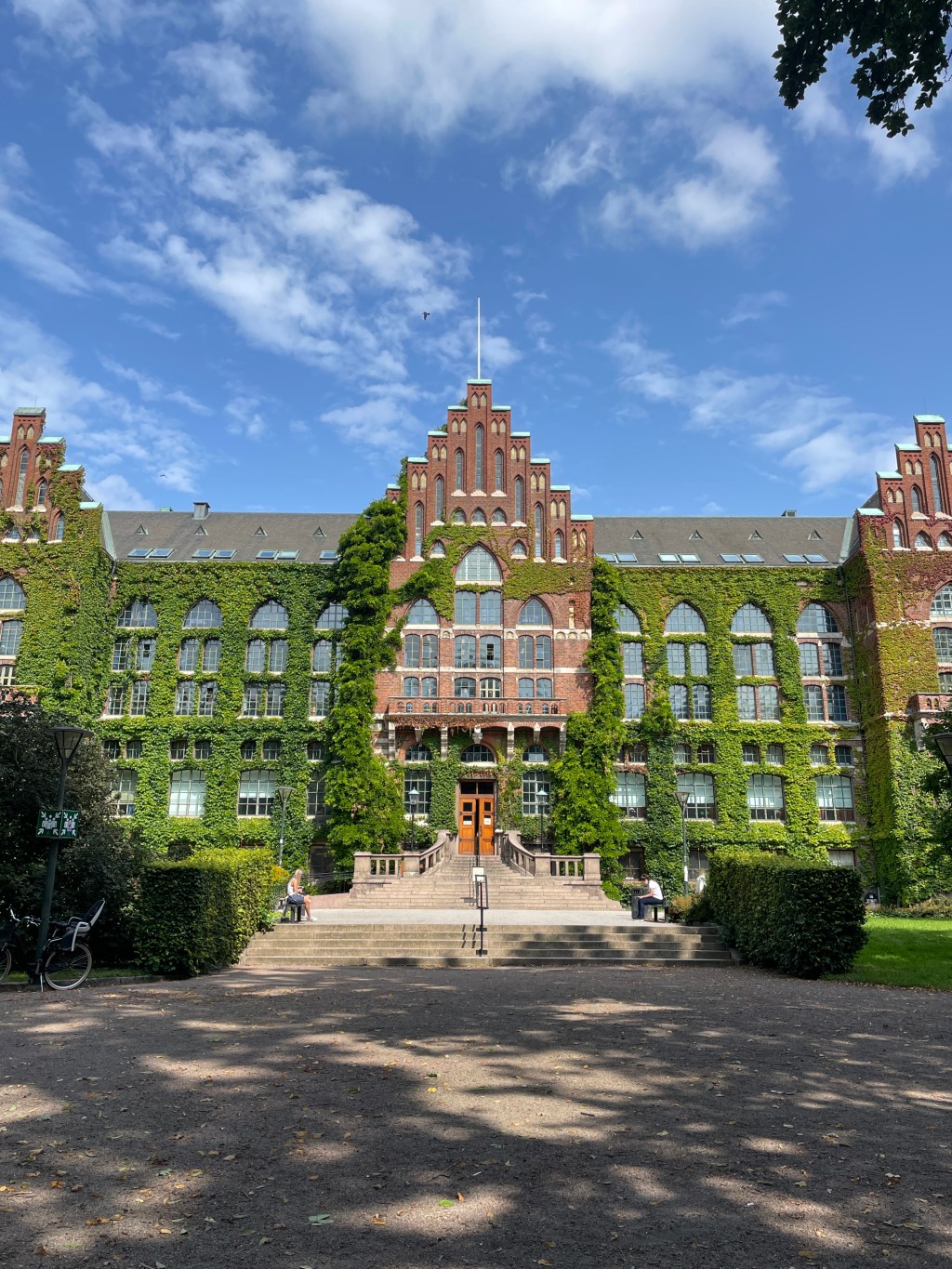
Hej! It’s already been 2 months since I’ve arrived in Lund to start my exchange at Lund University. Lund is located in the south of Sweden, approximately 1 hour away from Copenhagen which is super convenient to fly out of for travelling during the semester. The town is charming & old with a vibrant student life. There are historical university buildings scattered all around town, adding to the cosy vibe. The university has 25 libraries on campus for students to use and study!
I’m studying within the Lund University School of Economics & Management using my free electives from UTS. I chose to use my free electives as I wanted to study subjects that were different to finance and marketing major back home. I am currently studying Innovation Management, Global Strategic Marketing, Global Business Responsibility and Project Management – A Business Perspective which are all very collaborative subjects that highly encourage free thinking and discussion rather than sticking to a textbook.
I also took an introductory Swedish language course which was heaps of fun to learn some common phrases to impress the Swedes. Everyone speaks English quite fluently but a simple ‘tack’ (thank you) always puts a smile on their face. The classes are slightly different to UTS as lectures are not recorded and there are no tutorials. Having a lecture in a lecture hall for the first time was definitely a new experience as all my lectures at UTS were recorded. The semester is split into two periods so we only do two subjects at a time which is a very laid back system and there are retake exams?!
Being a student town, the social life is very extensive with events running almost every day organised by the 13 student nations. The nations are similar to a sorority or fraternity, I joined Göthenburg Nation and participated in their ‘Novisch period’ which is 2 weeks of events organised for new students. The events included a body pump session at the gym, a sports day, brunch and a lot of parties… It ended with a sittning which is a formal seated dinner with an afterparty, a Swedish tradition and a must do in Sweden! I met so many new people from all over all the world during this period and I highly recommend participating in any of the 13 nations’ Novisch period.
I’m currently living in a student corridor room which I was very lucky to get as housing in Lund is very competitive as the town is made up of mostly international students. I live with 9 other students, sharing a kitchen and living space which is a great way to socialise and make friends.
Tips if you are coming to Lund:
Buy a second hand bike: This will be your best friend for the 5 months you are here as it’s the easiest and fastest way to get around. Shop around the local stores for a decently priced second hand one or Facebook marketplace but beware of scams!
Join a student nation: The easiest way to meet new people in the first few weeks as there are always events on. Each nation has their own building to host events, lunches and dinners which are at a discounted price compared to normal town ones. They usually have lunch for around 45 SEK (around $7 AUD). Everyone is super friendly and welcoming even if you join a nation with mostly Swedish students like Göthenburg.
Plan your travels: It’s super easy to organise a trip to another country due to the close proximity of Lund to other European countries. Flights from Copenhagen are fairly cheap if you book early and at the right time. So far, I have had the opportunity to travel to Munich for Oktoberfest, Vienna, Estonia and Latvia! I’m planning to go to Iceland at the end of October and hopefully more. Classes are spaced out enough for travel on weekends or even a few days during the week.
Arrive on time for orientation week: Lund University organises a 2 week period before classes start for new students to settle in through events and activities. This is a great way of meeting people before classes start and just getting to know the town at your own pace.
Just say yes: Exchange is all about stepping out of your comfort zone and making the most of every opportunity presented to you. It’s normal to feel unsure about putting yourself out there in a new environment with no familiar faces. But just say yes to it, be open to new things and honestly you won’t regret it.
Overall, my exchange so far has been incredible and I definitely recommend it to anyone who is able to take this opportunity. It’s worth it and you’ll go home with unforgettable memories. I can’t wait to see what the rest of my exchange has in store for me!
Cathy Li Bachelor of Business Lund University Sweden