
Exchange at Aarhus University Denmark
Hello! Welcome to my little world of studying at Aarhus University in Denmark. Honestly, where to begin? Exchange has been quite the experience already, with a new academic style, university, and city as well.

I suppose I’ll begin by introducing myself. My name is Anna-Sophia, I am 22 years old, and love the beach, cooking, flowers and hanging out with friends. I am half Australian/half Danish, speak Danish fluently and have always loved Danish culture, their innovative way of thinking and their lifestyle, so thought Aarhus would be perfect for me.
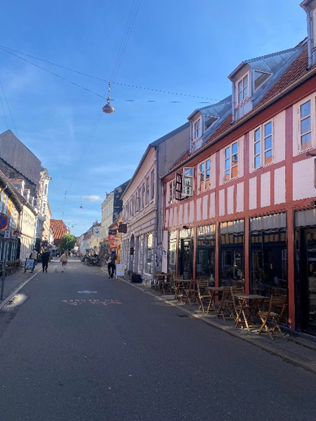
Aarhus is a super cute city of about 330,000 people and you will really get to live an authentic Danish life here. It is also a young city with a massive university life. The average age of a person in Aarhus is 24, so that speaks for itself.
Now I’ll get a bit into how my journey started, uni life, social life and all the practical components associated with this.
Uni Life
I am currently in my final semester of my 3rd year of a Bachelor of Biomedical Engineering (Honours) with a Diploma in Professional Engineering at UTS. I chose electives to go on exchange with, and selected Aarhus University’s Software Engineering Program.
I had done bits and pieces of software and programming during my degree so far and quite liked it, and I did a lot more during my first internship at Inventia Life Science, where I saw the importance of software engineering, skills and understanding to make R&D projects come alive. So, I wanted to give software engineering a go, and here I am!
This program covers 6 subjects (each worth 5 ECTS to make up 24 credit points) and is capped at 10 exchange students. The subjects I am currently doing are Software Engineering, Software Design, Machine Learning in Health Care Technology, Computer Games Technology, Advanced Front-end Development and Project Work. You can find more info here if you’re interested in their content: https://ingenioer.au.dk/en/education/international-programme/software-engineering

The cap of exchange students means that we are 10 software engineering students, from Switzerland, Germany, Poland, USA, Czech Republic, Iceland, and Taiwan who are all doing the same subjects and have the same classes. All classes are taught in English, and with a larger cohort of Danish students as well, so we generally average about 30-40 students per class.
Your timetable gets automatically generated for you, and you can’t control the days you are at uni, or timing of your classes. Lucky me, I got 3 x 8am classes in a row (ouch, I’m not a morning person). We are on the Computer Engineering campus, which includes almost all engineering fields except for Mechanical and Civil who are at ‘Navitas’ campus. It is a great campus with 2 main buildings.
The teaching style is very informal. The classroom environment really encourages people to speak up, engage in class discussion and people will actively tell the teacher mid-lecture if they don’t understand something. I have 1 class for each subject per week, which is scheduled for 4 hours. These normally finish at about the 2hour mark, and then there are exercises you are expected to finish afterwards.
This is great, but it also means that since tutorials aren’t scheduled into your timetable, you really need to keep on top of doing exercises and keeping up with course content in your own time.
Each subject has an exam, and you normally need to do 1-2 hand-ins throughout the semester to be eligible to attend the final exam. The final is a 20minute oral exam, where you have to explain your hand-in, and reasons why you made certain programming choices in the hand-in to your examiner (normally your lecturer) in a conversational like style.
Social Life
The orientation at Aarhus University was great. They had a couple of intro days, which I highly recommend attending just to get to know a couple of people. They have exchange and international events almost 2-3 times every week so there are lots of opportunities to get to know people.
Each faculty at uni has a ‘fredagsbar’ or ‘Friday Bar’. This is basically a bar, hosted by your faculty, that is only opens on Fridays, and it is really common to attend these at Aarhus. Personally, I really like the engineering one (a bit bias, I know), the medicine one and the business studies bar. There are lots of different types of bars and activities, so whilst some might focus more on drinking games, some bars, like the chemistry bar, have board game competitions as well. So, there is something for everyone!

There are lots of yummy cafes, bars, pubs, and restaurants around, and they fit a variety of budgets as well, so you don’t have to break the bank if you do cave to eating out.
Practical Parts – the boring (but important!) bits
When you apply for Aarhus University, you will be asked if you wish to be granted housing. You can select up to 3 types of housing accommodation you like, and you will (most likely because you’re coming from Australia, and they prioritise people who live far away), be given a housing offer. You receive 1 housing offer and need to accept or reject it within 48 hours. If you reject the offer, you will not receive another one. You can also look on the private housing market on Facebook if you wish to rent privately, or do not get an offer.
Once accepted to study at Aarhus University, you will get sent an email by your course co-ordinator who will ask you to specify what subjects you want to be enrolled in. Make sure you respond to that email with your subjects, by the deadline they provide.
You will be automatically enrolled at Aarhus University. Your timetable will be automatically generated, and you can’t change any of the classes. You can change subjects by their specified census date.
After receiving your housing contract, and moving into your new housing, you will need to visit Aarhus Borgerservice at Dokk1 to register your residency in Denmark. You also need to get a CPR number. You need to make an appointment online to do this, and there are specific days the university allocates for new international students, so just find a time on one of these days.
After you visit borgerservice, you should receive 2 cards. You will get your ‘Sysikringsbevisekort’ (a yellow card that states your right to free medical insurance in Denmark) and a Residence Permit Card (it proves your right to reside in Denmark, to travel around the Schengen region, and re-enter Denmark). The cards should take around a month to arrive. If you plan to travel around Europe before your Residence Card has arrived, you must apply for a free re-entry permit. This ensures you have proof that you are eligible to enter Denmark, even though you have a visa. You must apply within 7 days of your travel. Make sure you contact SIRI if you think something has gone wrong with your cards.
The End
So that is all! If you do choose Aarhus, you made a great pick, and that is all from me! 😊
Anna-Sophia Carter Omoe
Bachelor of Biomedical Engineering (Honours) Diploma in Professional Engineering Practice
Global Exchange Student at Aarhus University, Denmark
Categories

 UTS Think Global